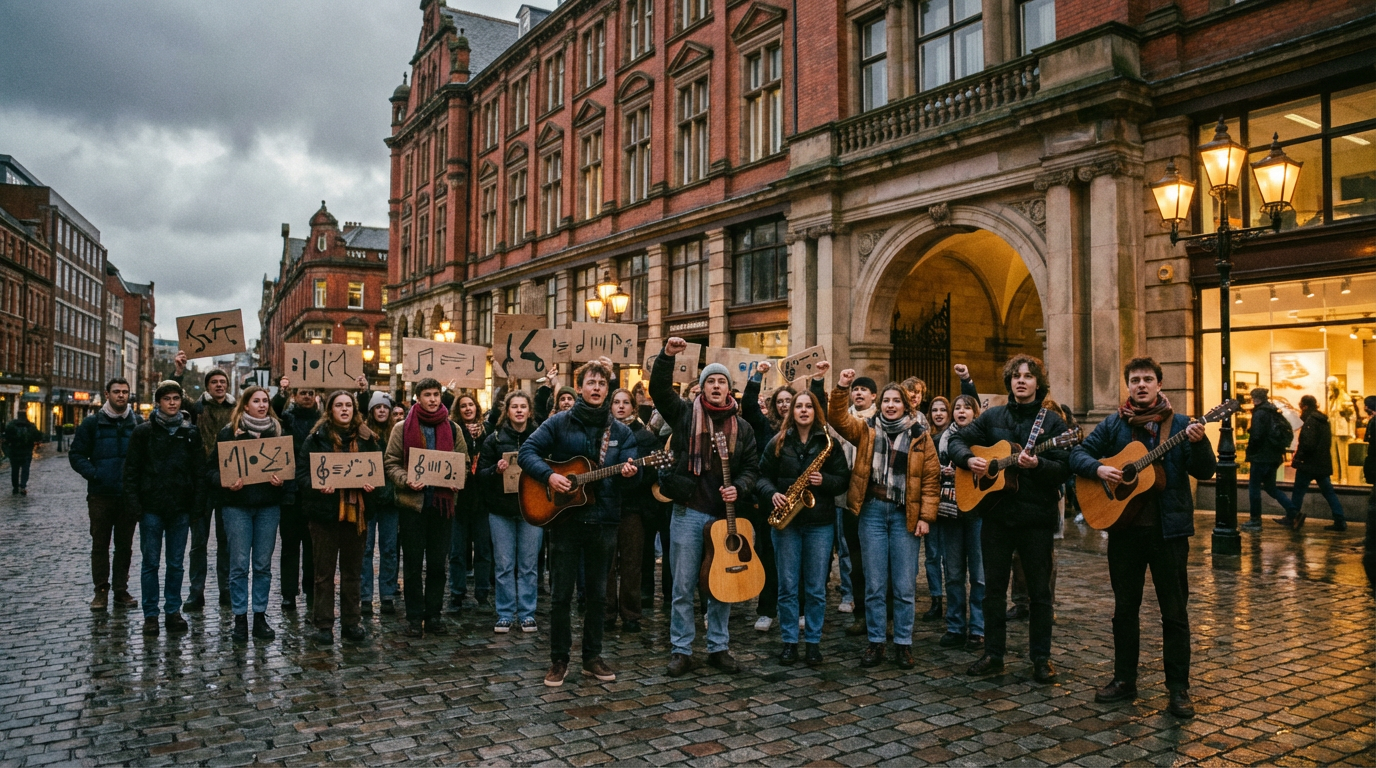
The AI Music War Erupting at Berklee in 2026
Something cracked open in the music world this April. Not a new algorithm. Not another funding round. A fault line — running straight through one of the most respected music schools on Earth.
Hundreds of students at the prestigious Berklee College of Music in Boston have signed an online petition protesting a new course on generative AI music and songwriting, marking another salvo in the continuing battle between artists and a technology they believe is stealing their hope for a livelihood.
The course is called “Bots and Beats: AI and the Future of Songwriting.” And it has become a lightning rod for every simmering tension in the music industry.
But Berklee isn’t an isolated incident. It’s the loudest crack in a dam that’s been straining for months. From Portland record stores to Spotify artist profiles to Nashville’s songwriting community, April 2026 has become the month where AI music stopped being an abstract debate and started feeling personal.
Let’s break down what’s actually happening — and what it means if you’re a musician trying to figure out how to navigate this moment.
The Berklee Revolt: “No AI at Art School”
More than 425 Berklee College of Music students and alumni have signed a petition demanding the cancellation of “Bots and Beats: AI and the Future of Songwriting” — an elective course that asks students to collaborate with AI tools like ChatGPT to generate lyrics, melodies, and full recordings.
The anger is real and specific. How would you feel paying $85,000 a year to one of the world’s most prestigious arts colleges, only to be taught how to eliminate your career? That’s how some students at Berklee College of Music view the Boston school’s growing efforts to educate them about using generative artificial intelligence.
What really poured gasoline on the fire is who’s teaching the class. Ben Camp, the associate professor who teaches the AI songwriting class, has ties to the AI music industry. Camp’s LinkedIn profile says they are an adviser to Suno, an AI music company based in Cambridge that can instantaneously create a song based on a simple prompt.
The irony hasn’t been lost on students or observers. A professor advising the very company that major record labels have sued for allegedly training on copyrighted music — now teaching future musicians how to use those same tools.
One professor described AI music output bluntly: “All I hear is seven-fingered, three-armed songs,” said Nicholas Urie. “I find it baffling that Berklee would want anything to do with it.”
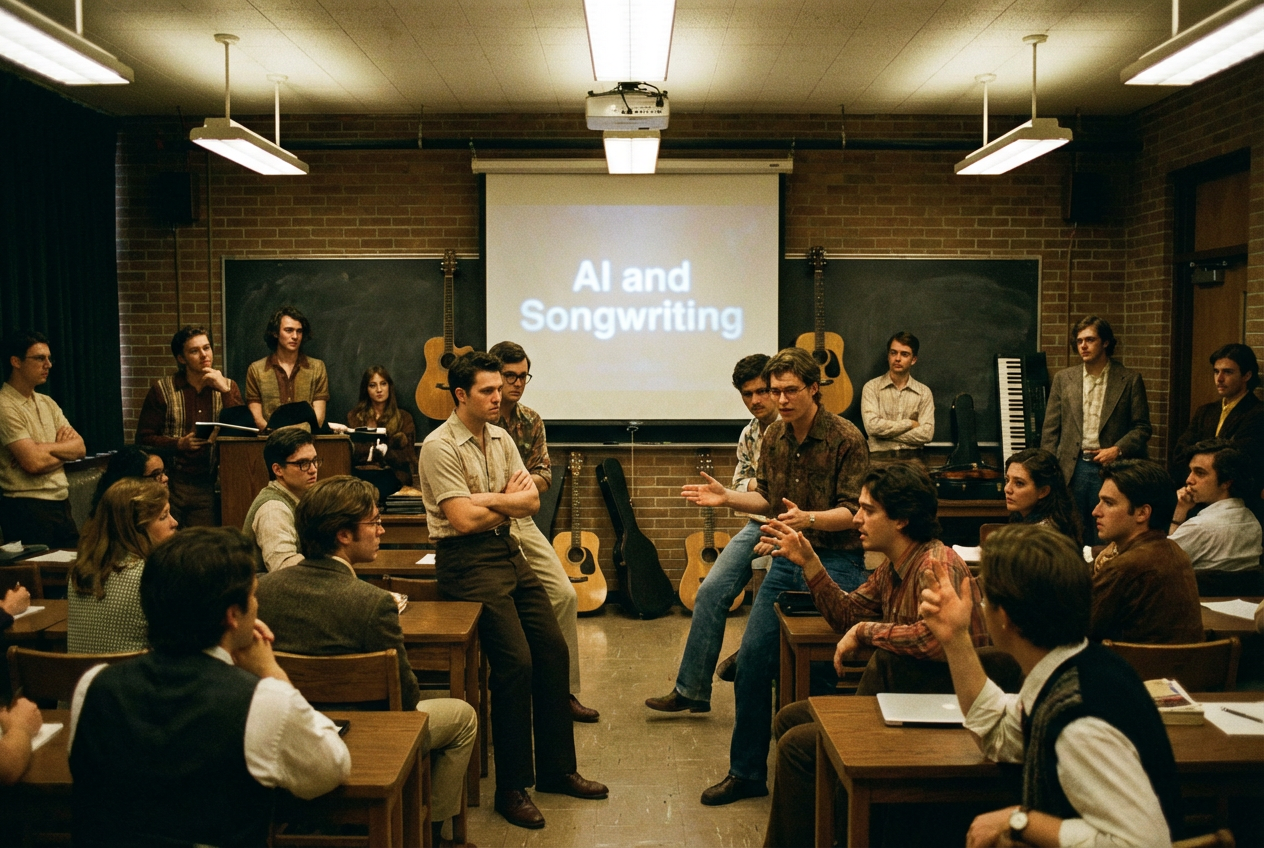
But Berklee isn’t backing down. In a statement to WBUR, Berklee said: “As an artist-first institution at the forefront of contemporary music and performing arts education, Berklee has a responsibility to prepare our students to navigate technologies impacting the creative industries. We will continue to do so, in keeping with our guiding principles.”
The school is also planning an AI Music Summit in June, which will dig into the ethical questions. Professor Marti Epstein has noticed a shift in her students’ attitudes toward AI. When she returned to campus last fall, she said, students were less trustful of AI than they had been the previous semester. Her students are worried about their futures, that their careers will be overtaken by AI, especially those studying songwriting and film scoring.
Portland’s Record Store Rebellion
While Berklee students were organizing petitions, a quieter but equally symbolic drama played out 3,000 miles west.
A Portland musician is at the center of controversy after Music Millennium canceled a listening event for a new album following backlash over the usage of artificial intelligence. Brandon Carmody created an entire album using an AI program called Suno. The album, titled “AI,” is intended to spark a broader conversation about society’s use of artificial intelligence.
What happened next was an uproar on social media in response to Music Millennium’s posts announcing the show, railing against the use of artificial intelligence in music. Commenters wrote that they were disappointed in the store, gave the event a thumbs down, and said it was hypocritical for a vaunted independent record store to promote robot-created music.
The store’s owner, Terry Currier, pulled the event. “There is a conversation to be had here. They are raising moral and ethical issues about traditional musicians, and I have to respect that. I have to take this moment to enter into an honest discussion,” he said.
Carmody himself isn’t some tech bro parachuting into music. He has been a musician in Portland since 1998 and says a Paul McCartney concert last year inspired him to try to make arena-sized music for the first time using AI.
That’s what makes the story so complicated. This isn’t a faceless bot farm. It’s a veteran musician who got excited by a new tool — and an entire community that told him, in no uncertain terms, that the tool is the problem.
The Spotify Profile Hijacking Crisis
If the Berklee and Portland stories represent the cultural front of the AI music war, Spotify’s ongoing crisis is the criminal one.
Numerous jazz musicians, including American pianist Jason Moran, and Danish musicians Carsten Dahl, Thomas Blachman, and Chris Minh Doky, face a deluge of AI-generated tracks — often entirely unrelated to their own work — uploaded to their official streaming profiles without consent.
Moran’s reaction was visceral and perfect: “There’s not even a piano player on this whole damn record.”
The scope of the problem is staggering. The streaming service Deezer said that 50,000 AI-generated tracks are uploaded to its platform every day, accounting for 34% of all new music. And Sony Music said in March that it had requested the removal of more than 135,000 AI songs impersonating its artists.
This isn’t theoretical harm. It’s real musicians waking up to find fake albums on their profiles, their fans getting notifications about “new releases” they never made, and having to play whack-a-mole with distributors to get them removed. If you’re a musician working in jazz, indie, or R&B — genres where audiences are smaller and every stream counts — this is an existential threat.
Meanwhile, the Tech Just Got Dramatically Better
Here’s what makes this moment so disorienting: while the backlash reaches fever pitch, the AI tools are making a quantum leap.
A mysterious AI video model that has ascended global leaderboards has been confirmed as a project under Alibaba. It’s called HappyHorse, and it appeared anonymously on the Artificial Analysis Video Arena on April 7, climbed to #1 in both text-to-video and image-to-video categories, and was only claimed by Alibaba three days later.
Happy Horse ranked first in the text-to-video (without audio) track with 1389 Elo points, leaving the second-place Dreamina Seedance 2.0 by nearly 115 points. It generates video and audio together in a single pass — a capability that makes music video creation dramatically easier.
HappyHorse was developed by Alibaba’s Taotian Future Life Lab, led by Zhang Di, former Vice President of Kuaishou and Head of Kling Technology. This isn’t some scrappy startup. It’s a team that already built one of the world’s best AI video models and then defected to build something even better.
And Google isn’t sitting still either. Google has upgraded its Vids platform with AI-powered video generation using Veo 3.1, custom music creation via Lyria, and directable AI avatars, making advanced video production tools available at no cost to all Google account holders.
OpenAI discontinued Sora on March 24, 2026. The platform was reportedly generating $2.1 million in lifetime revenue against $15 million per day in inference costs. The model that was supposed to define AI video couldn’t even pay its own electricity bill.
The net result? AI music and video tools are simultaneously getting better, cheaper, and more accessible — while resistance to using them is intensifying.
The Industry’s Uncomfortable Middle Ground
There’s a vibe shift happening in how the music industry is coping with its ongoing AI revolution, at least if you believe the man who is arguably the most responsible for starting that revolution: Mikey Shulman, CEO and co-founder of Suno.
“I don’t meet a lot of producers and songwriters who aren’t using Suno at least a little bit in their workflows. I think people are starting to be a little more comfortable being public and upfront about their use, and most importantly, I think a bit more optimistic about the future.”
But the major labels tell a more nuanced story. Udio carved out settlements and partnerships with Universal Music Group and Warner Music Group last fall, and Suno managed to settle with WMG back in November.
Sony, the only major label that hasn’t settled with either, remains in litigation with both companies.
And in Nashville, the effects are already tangible. As AI-assisted artists like Breaking Rust and Cain Walker climb the country charts, the country songwriting and publishing community will have to figure out how to deal with AI in a way that doesn’t continue the bloodletting in the songwriting and demo-making process.
Bandcamp has drawn the hardest line: any music and audio that is “generated wholly or in substantial part by AI” is outright banned from the platform. That decision was celebrated by artists and fans as proof that at least one platform still prioritizes human creativity.
What This Means for Musicians Right Now
Here’s the uncomfortable truth: both sides have a point.
The Berklee students are right that AI models are trained on copyrighted work, that the economic model threatens working musicians, and that an adviser to Suno teaching at Berklee is a conflict of interest that should have been disclosed more transparently.
But Berklee’s administration is also right that ignoring AI won’t make it go away. The tools exist. They’re improving at an absurd rate. And musicians who understand how to use them — or at least how they work — will have an advantage over those who don’t.
The real opportunity isn’t in replacing human creativity. It’s in augmenting it. And that’s especially true for music videos.
Think about it: writing a song is deeply personal. It comes from your experience, your voice, your perspective. AI-generated lyrics will always feel hollow to the artists who care about the craft.
But making a music video? That’s traditionally been a logistics nightmare — locations, crews, budgets, scheduling. It’s the gap between having a great track and having the visual content you need to promote it. This is where AI genuinely shines as a collaborator rather than a replacement.
If you’ve got an original song — one you wrote, performed, and produced yourself — creating an AI music video for that track doesn’t diminish your artistry. It extends it. You’re using AI for the visual layer while keeping the creative soul human.
Whether you’re making videos for hip-hop, pop, EDM, or country, the tools have gotten good enough in 2026 that a single musician can produce visual content that would have required a five-figure budget two years ago. Our complete guide to AI music videos breaks down exactly how.
Where the Line Should Be
After weeks of reporting on these stories, here’s where I think the line sits:
AI for music creation — still deeply controversial, legally murky, and legitimately threatening to professional songwriters and composers. The backlash is warranted.
AI for music visuals — a massive opportunity that helps independent artists compete with major label marketing budgets without compromising artistic integrity.
AI for impersonation and fraud — indefensible, and platforms need to do far more to stop it.
The Berklee students aren’t wrong to be worried. Some AI-generated artists have garnered millions of Spotify streams, with fake backstories and photos. Williams thinks Hollywood will embrace AI next, using AI-generated music in place of music composed by humans who must be paid.
But worrying isn’t a strategy. The smartest musicians in 2026 are the ones who draw their own lines — keeping the creative process human while using AI to handle the parts of music marketing that used to require a label’s backing.
The Path Forward
The next few months will be defining ones. Berklee is hosting an AI Music Summit in June, where organizers plan to explore the ethical questions around AI. Sony’s lawsuits against Suno and Udio are still active. And the AI video landscape is about to get even more competitive, with rumors of Google Veo 4 arriving by late April, with a hard launch deadline rumored for the end of May 2026.
The music industry has always been shaped by technology — from the phonograph to the synthesizer to Auto-Tune to streaming. Every time, there’s been a painful adjustment period where artists, labels, and fans renegotiate what “real music” means.
This time, the adjustment is happening at AI speed. And the stakes feel higher because the technology doesn’t just assist musicians — in some configurations, it can replace them entirely.
But here’s what hasn’t changed: audiences still crave authenticity. They still want to know there’s a human behind the music they love. The artists who will thrive are the ones who use AI as a lever for what they already do — not a substitute for what they can’t be bothered to learn.
If you’re a musician with original music and no budget for professional video production, that’s exactly the problem AI music video tools were built to solve. OneMoreShot.ai lets you turn your tracks into stunning music videos in minutes — keeping your creative vision intact while giving you the visual content you need to compete in 2026’s attention economy.
The war isn’t between humans and AI. It’s between musicians who adapt on their own terms and those who let the industry decide for them.
Choose wisely. And keep making music.