Why AI Visuals Win While AI Music Loses Fans
There’s a strange split happening in the music industry right now, and it tells you everything about where AI actually belongs in a musician’s toolkit.
On one side: listeners are increasingly uncomfortable with AI-generated music. On the other: AI-generated visuals for music are exploding. Startups are hitting million-dollar milestones. Musicians are shipping professional-grade videos in minutes. And nobody’s complaining.
If you’re an independent artist trying to figure out what to do with AI in 2026, this split is the single most important thing to understand.
The Numbers Don’t Lie: Listeners Are Rejecting AI Music
Let’s start with the uncomfortable data.
Luminate’s landmark study compared attitudes toward AI use in music creation from May to November 2025 and found that overall interest dropped from -13% to -20% during that period. That’s not a small shift — it’s a wholesale collapse in consumer goodwill.
The greatest decline came from Gen Alpha and Gen Z in particular, falling from net -6% to -16%. These are the exact demographics that streaming platforms and AI music companies are banking on. The very audience they need is the one running away fastest.
Luminate analyst Audrey Schomer, who authored the report titled “Generative AI in Entertainment 2026,” put it bluntly: “Across the board, what we found is that consumers are net negative. All that means is that people are more likely to feel uncomfortable than to feel comfortable with AI use.”
And the case study that drives this home? Xania Monet, the AI-powered R&B act whose creator Telisha Jones used Suno to make her music, attracted a bidding war and signed a multimillion-dollar deal with Hallwood Media. She was the poster child for AI music’s commercial potential. But Luminate notes that her music had over 7 million total weekly streams in September 2025, and by March 2026, her total weekly streams decreased to below 3 million.
That’s more than a 57% drop. The novelty wore off. The fans didn’t stick.
As Luminate detailed, AI-assisted artist projects often spark controversial headlines, leading to an influx of interest in hearing the music, but the quick decline in the months afterward suggests that these songs are not retaining true fans long term.
Meanwhile, AI Music Videos Are Quietly Booming
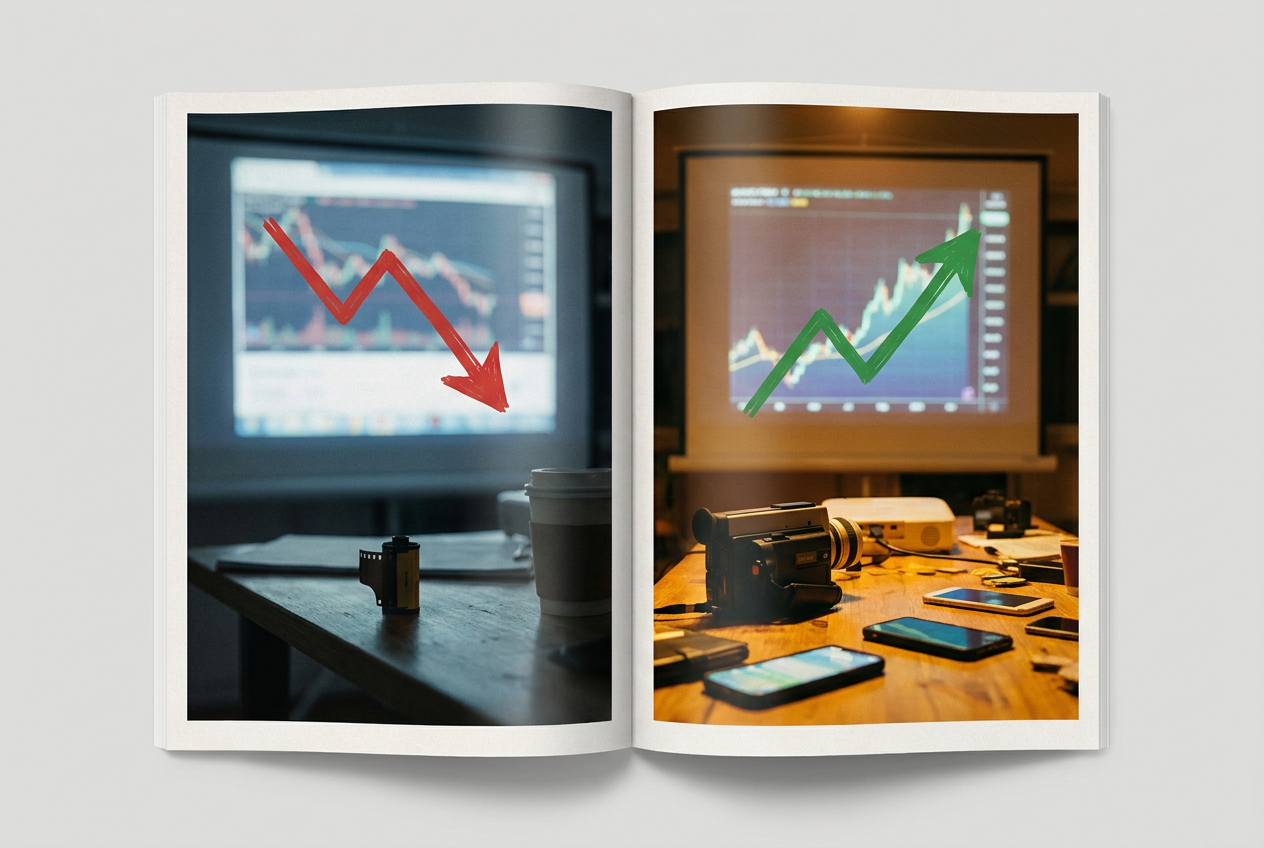
Now here’s the twist. While AI-generated music is facing a consumer trust crisis, AI-generated visuals for music are on a tear.
Berlin-based startup Neural Frames has built a platform for creating music videos using AI, and its annual run rate just crossed $5 million.
The platform has already been used by more than 40,000 musicians, who have collectively created over 2 million videos.
In just three years, founder Dr. Nicolai Klemke has grown the startup to a six-person team and healthy seven-figure annual revenue — completely bootstrapped, profitable, and with revenue that tripled last year.
And it’s not just Neural Frames. Artlist recently said it reached $300 million in annual recurring revenue and launched Artlist Studio, an AI production platform with shot-by-shot control.
The AI music video generator category has expanded rapidly in 2026, with more than 30 tools claiming this capability.
So what’s driving the difference? Why are listeners rejecting AI songs but embracing AI visuals?
The Psychology Behind the Split
The answer is simpler than you think, and it comes down to one word: authorship.
When a listener hears an AI-generated song, there’s an immediate question: who made this? The voice isn’t real. The emotion feels manufactured. The craft — the years of practice, the vocal training, the studio grind — is absent. As composer Gordon McGladdery put it at Tallinn Music Week 2026: “People appreciate effort. AI removes that effort.”
Luminate’s report found that sentiments are particularly negative toward new songs created by AI in the style or sound of an existing artist. The closer AI gets to imitating a real human’s musical identity, the more people hate it.
But AI visuals for music? That’s a completely different relationship. Nobody expects a musician to also be a filmmaker, a motion graphics designer, and a VFX artist. The music is still yours. The AI is just giving it a face.
This is the critical distinction that every musician needs to internalize: AI as a creative amplifier for your existing art is welcomed. AI as a replacement for your art is rejected.
If you want to dig deeper into how this plays out across genres, check out our Complete Guide to AI Music Videos in 2026 — it breaks down the full landscape.
China’s “Song-Washing” Crisis Shows What Happens When AI Music Goes Wrong
Still not convinced the backlash is real? Look at China, where AI music’s worst-case scenario is already playing out.
During Tencent Music Entertainment’s Q1 2026 earnings call, executives delivered one of the most direct warnings yet from industry leaders over the damage AI-generated content is doing to streaming subscription businesses in China.
CEO Ross Liang accused competitors of using infringing AI content “to quickly fill their music libraries” in a bid to attract users — a charge that carries particular weight in China, where TME faces intensifying competition from ByteDance’s Soda Music and NetEase Cloud Music.
The term they’re using? “Song-washing.” Tencent Music defines “song laundering” as the plagiarism or modification of existing works, and “trend hijacking” as content designed to exploit platform algorithms for commercial gain.
The scale is staggering: TME reported the removal of more than 250,000 songs from its platforms over the past year , and ByteDance’s Soda Music has grown from a quiet beta launch to reportedly more than 140 million monthly active users partly by filling its catalog with low-cost content.
Meanwhile, Deezer reported that approximately 44% of daily uploads are now AI-generated tracks.
This is the endgame of AI-generated music without guardrails: flooded catalogs, diluted royalties, and eroding trust. As a musician, you don’t want to be swimming in that pool.
The Smart Play: AI for Visuals, Human for Music
Here’s where the opportunity actually lives for independent musicians in 2026.
The music industry is in a period where your music needs to be demonstrably, proudly human. That’s your competitive advantage. The Luminate data shows that listeners actively prefer it. The backlash against AI music — from Kehlani and SZA publicly criticizing AI artists, to the “Say No to Suno” open letter — has created an environment where human authenticity is a genuine marketing asset.
But your visual content? That’s where AI should be doing the heavy lifting.
Think about the math. Music videos have always been expensive relative to the budgets of emerging artists. A professional shoot can run into five figures, and even a modest visual project can take weeks once planning, filming, editing, and platform formatting are included.
Today’s AI music video tools solve this equation entirely. You upload your (human-made) track, describe the visual world you want, and get back a synchronized, beat-aware video in minutes. Your song stays yours. The visuals amplify it.
For genre-specific approaches, we’ve put together detailed guides for everything from AI music videos for hip-hop and R&B to EDM and indie — each with templates and examples tailored to that genre’s visual language.
What the Tools Can Do Now
The AI music video space has matured dramatically. We’re past the era of acid-trip abstract visualizers (though those are still fun for lo-fi projects).
Modern AI music video generators analyze audio waveforms — detecting beats, energy shifts, and vocal patterns — and automatically synchronize visuals to music. The best ones don’t just overlay generic clips on your track. They structurally understand your song.
Neural Frames, for example, offers true audio-reactive capabilities — visuals that pulse and flow with your music through 8-stem analysis.
Their Text-to-Video Editor taps existing AI video models: Kling, ByteDance’s Seedance, Runway, and Stable Diffusion, allowing musicians to switch between them.
On the model side, Seedance 2.0, Veo 3.1, and Kling 3.0 all now produce video with synchronized audio in a single pass.
Native audio, 4K, and 60-second-plus durations are now table stakes — not differentiators.
The tools have reached a point where the quality ceiling isn’t the blocker anymore. The blocker is whether musicians know these tools exist and how to use them strategically. If you’re just getting started, our guide on how to make an AI music video walks through the entire process.
The Indie Week Signal
The timing here is significant. A2IM Indie Week — the premier gathering for the independent music community — is running June 8-11, 2026 in New York, bringing together label executives, artists, distributors, technology leaders, and attorneys.
Across panels and workshops, industry leaders are confronting the rapidly evolving role of artificial intelligence, exploring how to balance innovation with rights protection in an increasingly complex digital landscape.
A2IM CEO Ian Harrison has made it clear that AI policy is “job number one this year,” emphasizing the need to ensure “that we know the people at Suno and Udio, and that we’re talking to Spotify and YouTube about how they’re incorporating AI.”
The indie community is drawing lines. And the line they’re drawing runs right through the distinction we’ve been talking about: AI tools that serve artists are welcome. AI tools that replace artists are not.
Visual creation tools sit firmly on the right side of that line.
How to Apply This to Your Next Release
Here’s a practical framework for musicians who want to ride this wave correctly:
1. Keep Your Music Human
Write your songs. Record your vocals. Produce your tracks — or collaborate with human producers. This is now a competitive advantage, not just an artistic choice. As the AI music forecast for June 2026 puts it: “The safest long-term path is still to build your own sound.”
2. Use AI for Visual Content at Scale
Every single needs a video for YouTube. Every release needs short-form content for TikTok, Instagram Reels, and Spotify Canvas. AI music video tools let you generate all of this from one track in an afternoon. Check out templates for your genre — whether that’s rock, pop, or Latin.
3. Build Visual Identity, Not Just Visual Content
The best AI video tools now support character consistency and custom style training. Use this to build a recognizable visual brand across releases. Your aesthetic becomes part of your artist identity — and it costs a fraction of what traditional video production would run.
4. Be Transparent
If your visuals are AI-generated, own it. The backlash against AI is primarily about deception and replacement. When you say “I wrote this song, recorded it, and used AI to visualize it,” nobody’s mad. They’re impressed by your resourcefulness.
5. Move Fast
The music video has become a marketing requirement long before most independent artists can afford a traditional production. TikTok, Instagram, YouTube Shorts, and Spotify Canvas have trained audiences to expect motion around every release. AI visuals let you meet that expectation without breaking the bank.
The Bottom Line
We’re living through a fascinating moment where the music industry is simultaneously embracing and rejecting AI — and the dividing line is clearer than most people realize.
AI-generated music is facing a genuine consumer trust crisis. Streams are declining. Listeners are skeptical. 42% of listeners say they’d be less interested in listening if a song is labeled as AI-made. The industry’s biggest markets are dealing with “song-washing” scandals. Young people — the industry’s future — are the most turned off.
AI-generated visuals for music are thriving. Startups are profitable. Musicians are creating millions of videos. The tools are genuinely good. And most importantly: nobody questions an artist’s authenticity because their video was made with AI.
The strategy writes itself: be human where it counts, and let AI amplify where it helps.
Ready to give your human-made music the visual treatment it deserves? OneMoreShot.ai lets you create stunning music videos from your tracks in minutes — no film crew, no five-figure budget, just your music and your creative vision. Give it a try and see what your songs look like when AI handles the visuals.