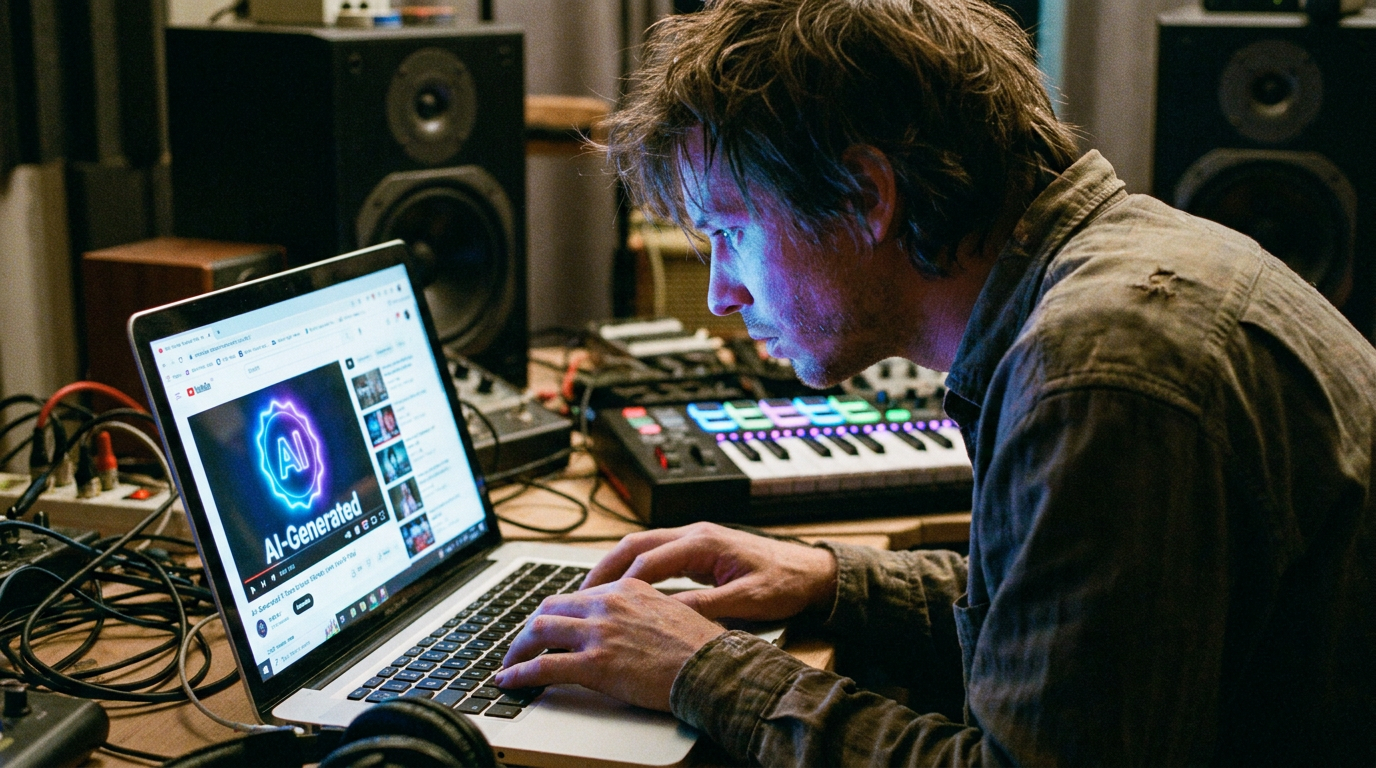
YouTube Now Auto-Labels AI Videos (What Musicians Must Know)
Yesterday, YouTube dropped one of the most consequential policy updates in recent memory for anyone making music videos with AI. And most musicians haven’t caught up yet.
YouTube is making AI-generated content labels more prominent for viewers — and it’s going to start automatically applying the labels if it detects that a video includes “significant photorealistic AI use.” Not someday. Not “in a future update.” Starting now, in May 2026.
This is a big deal. If you’re an independent artist using AI to create visuals for your music — and millions of you are — this changes how your work gets presented to every single viewer. Let’s break down exactly what happened, what it means, and how to turn it into an advantage.
What YouTube Actually Announced
YouTube has heard “consistently from our community that they value transparency when it comes to generative AI content.” The platform has been labeling content when creators disclose they’ve used AI tools since 2024, and now they’re making two major updates they believe will make the process “much simpler and more intuitive for creators and viewers.”
Here are the two key changes:
1. Auto-Detection Is Live
Starting in May 2026, YouTube is rolling out “new internal signals” to identify AI-generated content. If a creator doesn’t specify whether or not they used AI, but YouTube’s systems detect significant photorealistic AI use, the platform will now automatically apply a label.
Let that sink in. You no longer get to decide whether your AI music video wears a scarlet letter. YouTube’s algorithms will decide for you if you don’t disclose first.
2. Labels Are Moving Front and Center
YouTube is moving the disclosure label for photorealistic AI content to a much more prominent position. For long-form videos, the label will now appear directly below the video player, above the description. For Shorts, the label will appear as an overlay on the video itself. “By moving these labels on to the main stage, viewers get the context they need at a glance.”
Previously, these labels were buried in the expanded description — a place roughly zero percent of viewers ever look. Now they’re impossible to miss.
The Music Video Loophole (That Actually Isn’t One)
Here’s where it gets genuinely interesting for musicians. Music Business Worldwide noted that “for music, the implications are pointed: the prominent label will apply to photorealistic AI music videos but not to stylized or animated ones, creating an implicit incentive for artists experimenting with AI visuals to favor the latter.”
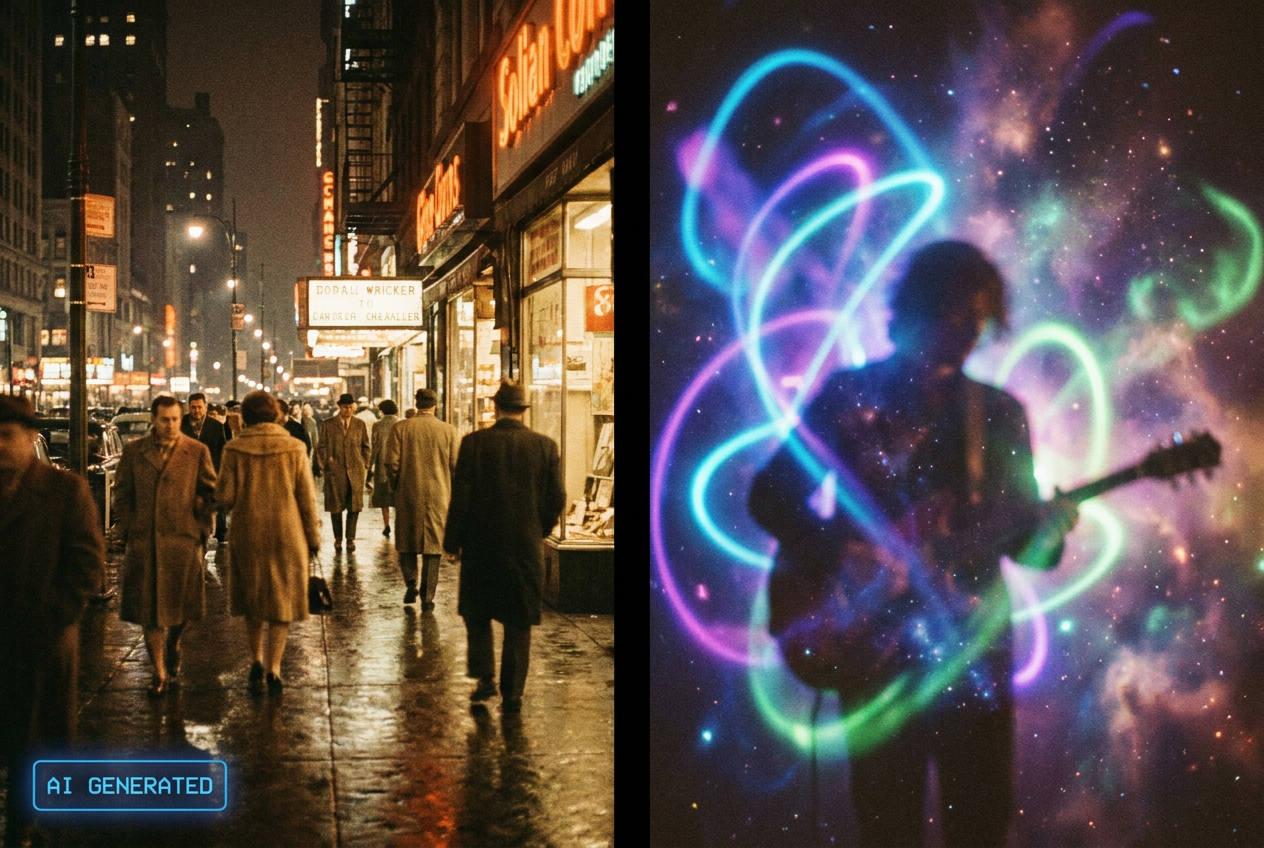
Read that again. YouTube is drawing a line between photorealistic AI content and stylized or animated AI content. If your AI music video looks like it could be mistaken for real footage of a real person in a real place, it gets the prominent label. If it’s clearly artistic, abstract, surreal, or animated? That content’s disclosure will only appear “in the expanded description” — essentially remaining invisible to most viewers.
This isn’t a loophole. It’s a design philosophy. YouTube is saying: the issue isn’t that AI exists in creative work. The issue is when viewers can’t tell what’s real.
For musicians, this is arguably a gift. The most visually striking AI music videos have always leaned into the surreal, the impossible, the stylized. Nobody watches a music video with floating geometry and impossible camera moves and thinks it’s a documentary. The aesthetic freedom of AI video generation — the very thing that makes it so powerful for artists — is exactly what keeps you out of the prominent-label zone.
What Happens If You Don’t Disclose
YouTube is still asking creators to self-disclose first. But the enforcement teeth are real now.
If a creator hasn’t disclosed whether they used genAI tools and YouTube’s systems “detect significant photorealistic AI use,” the platform will automatically apply an AI label. If the creator believes the label was erroneously included, they can update their disclosure.
But — and this is the critical part — the AI labels will “remain permanent” in some cases, including for content created using YouTube’s own AI tools (such as Veo or Dream Screen) and for content that contains C2PA metadata indicating it was fully AI-generated.
So if you’re using Google’s own Veo to generate video clips for your music video, that label is forever. No appeals. No exceptions. Recently, OpenAI committed to the C2PA standard, joining Nvidia, Kakao, and ElevenLabs — meaning the permanent-label net is only getting wider.
The Good News: Labels Don’t Kill Your Revenue
Let’s address the fear directly. YouTube says that AI labels won’t have an impact on how a video is recommended or its ability to monetize.
YouTube explicitly stated: “These changes are designed to balance transparency with creator control. It’s important to note that a disclosure label alone does not change how a video is recommended or whether it’s eligible to earn money.”
So your AI music video won’t get shadow-banned. It won’t be pulled from recommendations. It won’t lose ad revenue. The label is informational, not punitive.
At least, that’s the policy today. And this is where musicians need to think strategically.
The Psychology Problem Nobody’s Talking About
Here’s the uncomfortable truth. A peer-reviewed study published in March found that listeners engage less deeply with music labeled as AI-generated — even when the music was actually human-composed.
Let that hit you. Even when the music is entirely human-made, slapping an “AI” label on it makes people listen less carefully, feel less connected, and rate it lower. The label itself changes perception.
Now imagine you’re an indie artist who used AI to generate a gorgeous music video for your very human, very real song. YouTube detects the AI visuals and auto-labels the whole video. A viewer sees “AI-generated content” and their brain files you away in the same category as Suno-generated spam. Your human artistry gets caught in the AI skepticism crossfire.
This is the real stakes of the labeling conversation — and exactly why smart visual strategy matters more than ever.
The AI Flood That Forced YouTube’s Hand
YouTube didn’t make this move in a vacuum. The entire music industry is drowning in AI-generated content, and platforms are scrambling to build dams.
Deezer revealed in April that it’s now receiving almost 75,000 AI-generated tracks per day, representing roughly 44% of daily uploads — amounting to more than 2 million AI-generated tracks uploaded per month. The growth trajectory is staggering: the number has surged from 60,000 tracks per day in January, up from 50,000 in November, 30,000 in September, and just 10,000 when Deezer launched its AI detection tool in January 2025.
Despite the upload flood, AI-generated music sits at between 1% and 3% of total streams on Deezer. Around 85% of those streams have been detected as fraudulent and demonetised, suggesting the AI flood is being driven more by streaming-fraud actors than by genuine listening demand.
Meanwhile, Sony Music Entertainment revealed at the launch of the IFPI’s Global Music Report 2026 in March that it had asked streaming platforms to take down more than 135,000 songs created by fraudsters using generative AI to impersonate its artists.
With 20 million videos uploaded every day to YouTube, the task of policing that content is daunting. Auto-detection isn’t just nice-to-have anymore — it’s survival infrastructure.
The Broader Platform War on AI Slop
YouTube isn’t alone. Every major platform is now building or deploying AI detection:
-
Deezer was the first to detect and tag AI music at the platform level, claiming to have detected and tagged more than 13.4 million AI tracks over the course of 2025.
-
Apple Music launched its Transparency Tags system in March, asking labels and distributors to declare AI-generated content at the point of delivery.
-
YouTube’s likeness detection tool was first launched in October 2025 to a limited group of creators, before being extended to celebrities and talent agencies — including CAA, UTA, WME, and Untitled Management — in April 2026.
The direction is clear: platforms want to know what’s AI, they want viewers to know what’s AI, and they’re building the technology to enforce it whether creators cooperate or not.
How Smart Musicians Should Respond
Okay, so what do you actually do with all this? Here’s the playbook:
1. Always Self-Disclose First
Don’t let YouTube’s algorithm label your video for you. If you self-disclose, you control the narrative. You can explain in your description that the visuals are AI-generated while the music is 100% human. Context matters. A blanket “AI-generated” label from YouTube’s auto-detector doesn’t give you that nuance.
2. Lean Into Stylized Visuals
This is the single biggest takeaway from yesterday’s announcement. YouTube’s auto-detection and prominent labeling targets photorealistic AI content. Stylized, abstract, surreal, and animated AI visuals get the lighter treatment — description-only disclosure that most viewers will never see.
This is great news for genres like EDM, lo-fi, and indie where surreal visuals are a feature, not a bug. Even hip-hop and pop artists can build incredible visual identities using stylized AI that won’t trigger the prominent label.
3. Think About Your Visual Brand Holistically
The era of “make it look as real as possible” for AI music videos may be over — or at least, it now carries a visible cost. But honestly? The most memorable music videos in history were never photorealistic. They were expressive. Think about what visual language fits your music. Check out our complete guide to AI music videos for inspiration across every genre.
4. Build Your Video Before the Algorithm Decides
Speed matters now. If you upload without disclosing and YouTube’s systems flag your video, you’re starting from a defensive position. If a creator believes their authentic content was falsely flagged by automated systems, they can appeal and update the disclosure status in YouTube Video Manager. But that process takes time, and first impressions with viewers are already made.
5. Use the Right Tools
Not all AI video tools handle style the same way. Some default to photorealistic output. Others — like OneMoreShot.ai — are designed specifically for music videos and give you creative control over the visual style from the start. When you can direct the aesthetic, you can choose to stay in the stylized lane that YouTube treats more favorably. Our guide to making AI music videos walks you through the whole process.
The Bigger Picture: Transparency Is Winning
Step back and look at the trend line. In 2024, platforms asked nicely. In 2025, they started building detection tools. In 2026, they’re auto-labeling without permission. By 2027? It’s not hard to imagine AI disclosure becoming as automatic and invisible as Content ID matching.
YouTube CEO Neal Mohan identified managing “AI slop” and detecting deepfakes as priorities in his annual letter in January 2026.
YouTube’s Global Head of Music, Lyor Cohen, said in a March letter to the music industry that YouTube is “doubling down” on systems like Content ID to “build new guardrails for likeness detection” while “combating the spread of low-quality AI content.”
The message from every major platform is the same: AI is welcome, but transparency is mandatory.
For musicians, this is ultimately a good thing. The AI slop farms that flood platforms with garbage devalue everyone’s work. Better detection means the fraud gets filtered, the real creators get heard, and the musicians using AI as a genuine creative tool get to stand out on merit.
Your Move
YouTube’s auto-labeling changes are live this week. Every AI music video uploaded from now on will exist in this new transparency framework.
The musicians who will thrive aren’t the ones trying to hide their AI use or game detection systems. They’re the ones who own their creative process, lean into the visual styles that make AI magical rather than deceptive, and build audience trust through honesty.
If you’re ready to create AI music videos that are unapologetically stylized, artistically bold, and built for this new era of transparency, start building with OneMoreShot.ai. Your music deserves visuals that are as original as you are — no labels required.