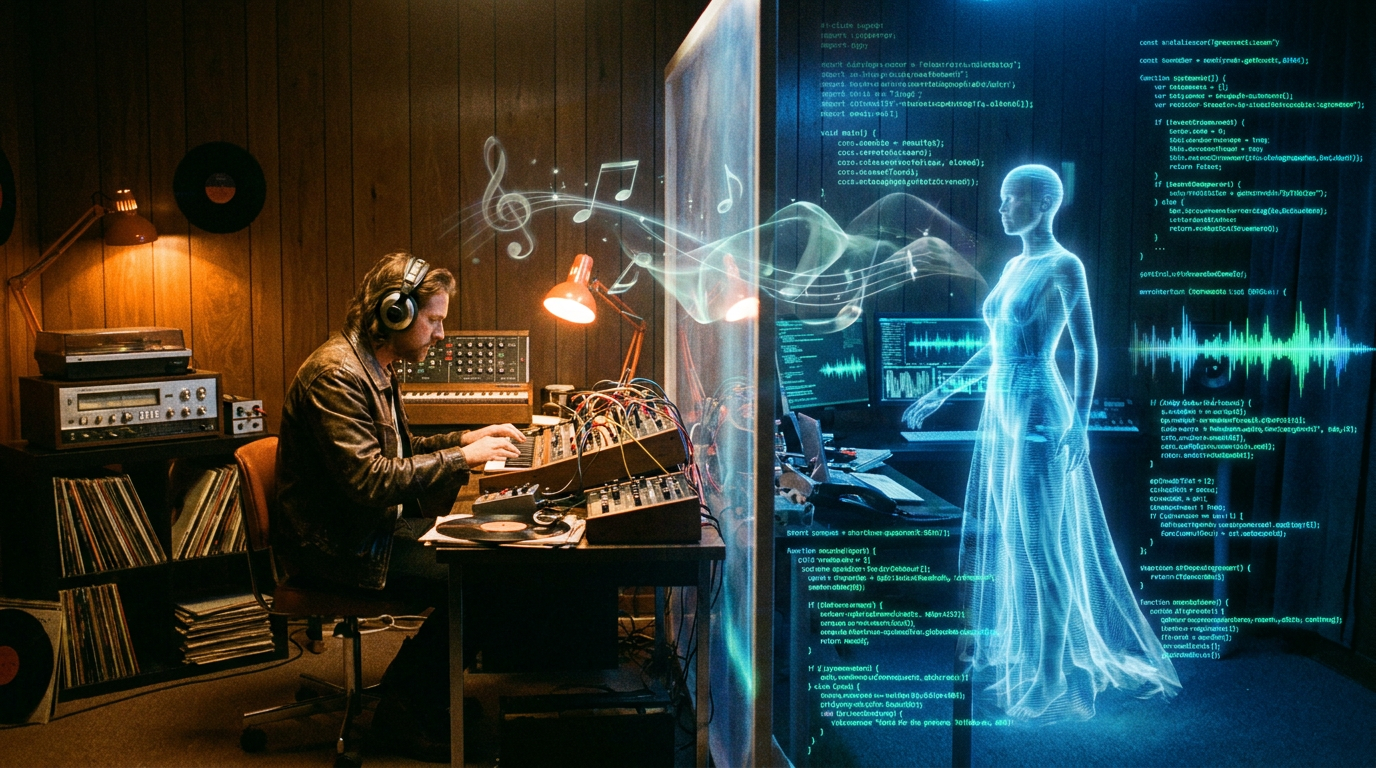
AI Music Just Hit 44% of All Uploads in 2026
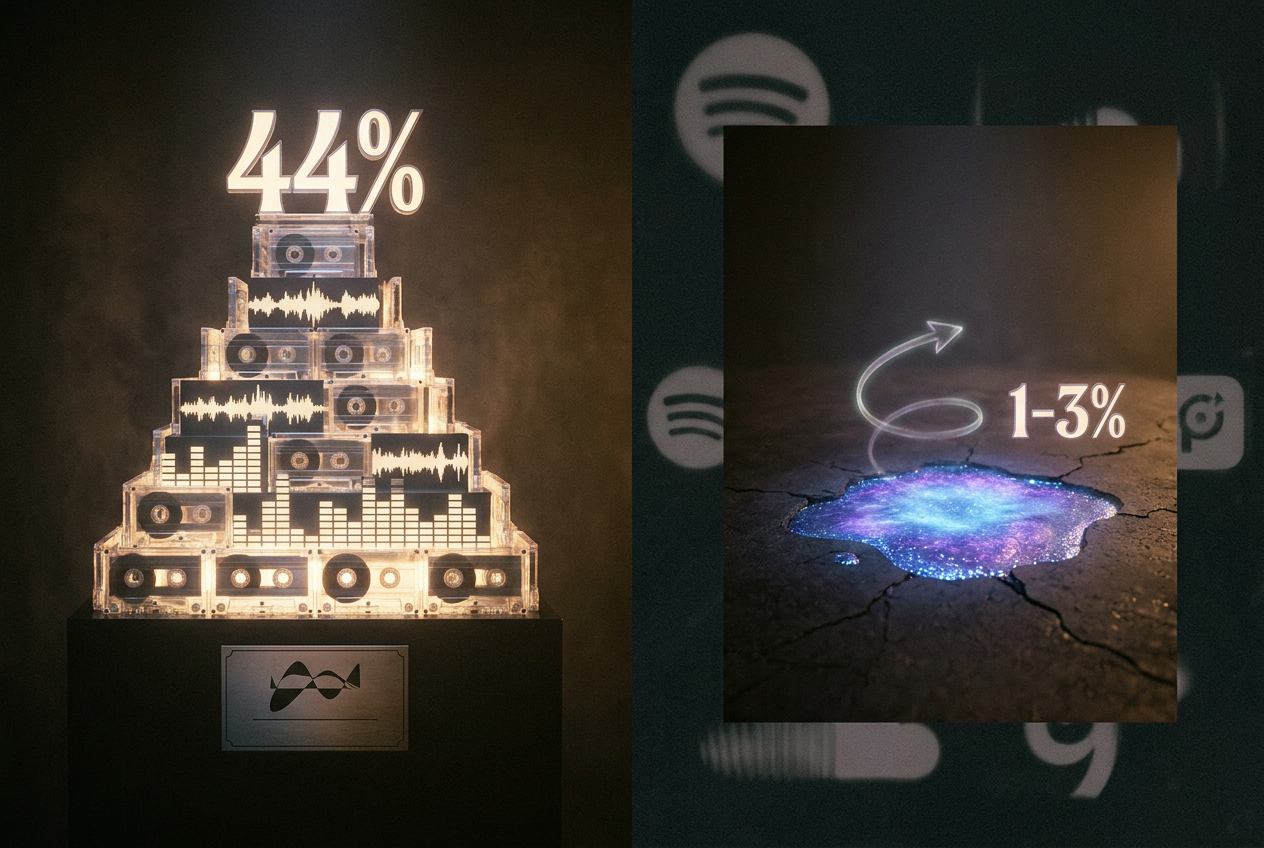
Let’s talk about the number that should be tattooed on every independent musician’s brain right now: 44%.
As of April 20, 2026, Deezer is receiving almost 75,000 AI-generated tracks per day, representing roughly 44% of daily uploads.
Apple Music reports that over one-third of its uploads consist of 100% AI-generated music. And two weeks ago, an AI-generated artist climbed to the top of the iTunes charts, with IngaRose’s track “Celebrate Me” reaching No. 1 globally.
If you’re an indie musician reading this in May 2026 and you’re not thinking about what this means for your career, your discoverability, and your visual presence — you’re already behind.
The Numbers Are Staggering (and Accelerating)
Here’s what makes this moment different from the vague “AI is coming” warnings of 2024: we now have hard data, and it’s terrifying.
Deezer reported receiving around 60,000 AI tracks per day in January, up from 50,000 in November, 30,000 in September, and just 10,000 in January 2025, when it first launched its AI-music detection tool. That’s a 7.5x increase in 15 months. The growth curve isn’t slowing — it’s steepening.
Fully AI-generated music now accounts for more than 44% of all new tracks delivered to Deezer daily, according to the company. Meanwhile, Apple Music is moving to tighten controls around synthetic songs after saying more than a third of uploads are now fully AI-generated, even though such tracks account for less than 0.5% of listening on the service.
That last stat is actually the most interesting part of this whole story. And it’s where the opportunity lives for real musicians.
The Great Paradox: 44% of Supply, 1-3% of Demand
Here’s the plot twist nobody’s talking about enough: the consumption of AI-generated music on the platform is still very low, at 1-3% of total streams, and 85% of these streams are detected as fraudulent and demonetized by the company.
Read that again. Nearly half the music flooding streaming platforms is AI-generated, but almost nobody is actually listening to it voluntarily. And of the tiny fraction being “listened to,” the vast majority is bot-driven fraud — Deezer estimates that 85% of the streams coming from these AI tracks are fraudulent. Essentially, bots are listening to bots, draining the royalty pool without a single human ear involved.
The market has spoken: listeners still crave human artistry. But the economics are getting squeezed anyway, because the royalty pool is being diluted by volume.
The IngaRose Moment: When AI Hit #1
The event that crystallized this entire crisis was IngaRose — a synthetic R&B artist who doesn’t exist as a real person — reaching the top of the iTunes charts in multiple countries.
The song is now at the top of the iTunes charts in the UK, France, the US, New Zealand and Canada.
It initially gained traction on TikTok, where IngaRose has over 220,000 followers. More than 300,000 videos on the platform have used the song.
IngaRose is a female R&B performer created from whole cloth.
IngaRose’s Instagram bio says the songs use “Human-written lyrics” and are “refined using Suno,” an AI music platform.
Five of the top 100 songs on U.S. iTunes as of that week were by IngaRose.
Now, the iTunes chart operates on downloads rather than streams, which makes it easier to game than Spotify or Billboard. But the optics matter enormously. An AI-generated song sat at #1 on a globally recognized chart, and the music industry collectively lost its mind.
For human musicians, this isn’t a death sentence — it’s a wake-up call. The question isn’t whether AI can make a catchy song (it clearly can). The question is whether you can offer something AI fundamentally cannot.
The Platforms Are Fighting Back (Sort Of)
Every major streaming platform is now scrambling to respond, but their approaches differ wildly:
Deezer is the most aggressive. Songs tagged as AI-generated on Deezer are automatically removed from algorithmic recommendations and not included in editorial playlists.
The platform has now stopped storing hi-res versions of AI-generated tracks. And it’s now selling its detection technology to other platforms.
Apple Music is taking a lighter approach. Apple will introduce ‘Transparency Tags’, a metadata system allowing labels to disclose whether AI was used in a song’s production.
This disclosure will be optional for content providers. So… voluntary labeling. That’ll definitely work.
Spotify has been somewhere in the middle — combined with Spotify’s 75M removals of spammy tracks, the platform is cracking down, but other major streaming services are pursuing AI transparency via supply-chain self-disclosure rather than platform-level detection.
The takeaway? Detection and labeling are getting better, but the sheer volume of AI content means discoverability for human artists is being diluted regardless.
97% of Listeners Can’t Tell the Difference
Perhaps the most unsettling data point from this entire saga: 97% of people couldn’t tell the difference between fully AI-generated music and human-made music in a blind test with two AI songs and one real song, and 80% of people agree that 100% AI-generated music should be clearly labeled to listeners.
Let that sink in. People can’t identify AI music by listening, but they overwhelmingly want to know when they’re hearing it. That cognitive dissonance is everything. It tells us that “being human” is a branding advantage as much as a sonic one.
52% of respondents said 100% AI-generated songs shouldn’t be included in charts alongside human-made songs. The audience is on your side — they just need to know you exist.
The $4 Billion Threat: What CISAC Predicted Is Happening
This isn’t just vibes. While the revenues of Gen AI providers will see dramatic growth over the next five years, creators risk losing a large share of their current income due to AI’s substitutional impact on human-made works. Despite providing the creative fuel of the Gen AI content market, music and audiovisual creators will see respectively 24% and 21% of their revenues at risk of loss by 2028.
For music creators alone, there will be a cumulative loss of €10 billion ($10.5 billion) between 2023 and 2028, with annual losses of €4 billion ($4.2 billion) by that year.
We’re not at 2028 yet, but the trends Deezer is reporting suggest these numbers might be conservative. When 44% of uploads are synthetic and growing by thousands per day, the pressure on the royalty pool is real and immediate.
AIMPRO: The Controversial Birth of AI Music Rights
Adding another layer to this story, Aimpro is pitching itself as “the first PRO designed to serve creators of generative AI works, allowing AI music creators to collect royalties for their work on a global basis.”
AIMPRO was announced Saturday, March 28, at the AlgoRhythms conference in Bloomington, Indiana, as the first PRO built specifically for generative AI music. It enters one of the core systems of the music industry: how creators get paid when their work is used. Performance rights organizations track when music is played publicly and distribute royalties to the people behind it. That includes radio, live venues, television, and other commercial uses. In the U.S., organizations like ASCAP, BMI, and SESAC operate on the assumption that songs have clearly defined human authors.
The reaction from the traditional music world was, predictably, volcanic. Can AI prompters be entitled to compensation when the original musicians are still being denied it?
AIMPRO is attempting to legitimise AI-generated music by advocating for prompters to be treated as creatives entitled to compensation. But these prompters are generating music using systems built on the work of human musicians. They are using words to produce outputs that rely entirely on pre-existing creative labour.
Whether you think AIMPRO is visionary or offensive, its existence tells you something important: AI music is building institutional infrastructure. It’s not going away.
What This Means for Indie Musicians Right Now
Here’s the optimistic read: the data proves that humans still dominate engagement. AI dominates volume but not attention. That gap is your competitive advantage — if you know how to exploit it.
1. Your Visual Identity Is Now Your Moat
When 97% of people can’t distinguish AI music from human music by ear alone, the differentiator moves to everything around the music: your face, your story, your aesthetic, your music videos.
This is exactly why AI music videos are so strategically important for human musicians. You’re not using AI to replace yourself — you’re using it to amplify your very human identity across every visual touchpoint. A compelling AI music video isn’t a contradiction; it’s a survival tool.
2. Genre-Specific Visual Branding Matters More Than Ever
AI slop tends to be generic — mood music, functional audio, the sonic equivalent of stock photography. If you make hip-hop, R&B, or indie rock, lean hard into genre-specific visual identities that AI personas simply can’t replicate with authenticity.
A Suno-generated track might sound like decent R&B. But it can’t show up to a listening party, share the story behind the lyrics on Instagram Live, or drop a music video that connects a specific neighborhood to a specific emotional moment. You can.
3. Speed Is the New Currency
The platforms that are fighting AI spam are doing so by surfacing quality human content more aggressively. But to benefit from that curation, you need to be present — consistently releasing visual content alongside every track.
The old model of spending $10K on one music video per album cycle is dead. You need visuals for every single, every loosie, every snippet. Check out our complete guide to AI music videos for how to build that pipeline.
4. Cross-Genre Experimentation Sets You Apart
One advantage human musicians have: genuine artistic range. If you make lo-fi beats but also experiment with jazz influences, that cross-pollination creates a fingerprint that AI generators — which tend to optimize for genre purity — can’t easily replicate. Your weirdness is your asset.
5. Community Is Unfakeable
IngaRose got 220K followers on TikTok, sure. But those followers are engaging with a concept, not a person. They can’t go to a show. They can’t get a vinyl signed. They can’t share a real story about meeting the artist.
Build your community around your humanity. Use AI-powered music video tools to create stunning visuals at scale, but make sure every piece of content has you at the center — your face, your voice, your story.
The Bottom Line
April 2026 will be remembered as the month AI music crossed the Rubicon. Nearly half of all new music on major platforms is now machine-generated. An AI song topped the iTunes charts in five countries. A performance rights organization launched specifically for AI prompters. And yet — and yet — human listeners are still overwhelmingly choosing human music.
The window of opportunity is right now. Not next year. Right now.
The musicians who will thrive in this environment are the ones who pair genuine human artistry with smart use of AI tools for everything surrounding the music: visuals, distribution, content velocity.
That’s exactly what OneMoreShot.ai is built for. Upload your track, generate stunning music video visuals in minutes, and make sure your very human music gets the very visible packaging it deserves — before the algorithmic noise drowns everything out.
The robots are making the music. It’s time to make sure the humans are impossible to ignore.