AI Music Video Tools Just Became Their Own Category
Something quietly historic happened in the AI video world this year, and most musicians missed it.
AI music video generators stopped being a feature inside general-purpose video tools. They became their own category. Not a subcategory. Not a filter. A full-blown product segment with dedicated platforms, specialized benchmarks, and an adoption curve that’s leaving the generic tools in the dust.
According to CNET’s April 2026 analysis, the AI video sector now splits into four main segments: enterprise video tools, creative editing suites, free consumer platforms, and specialized music video generators. That last one didn’t exist as a recognized segment twelve months ago. Now it has its own rankings, its own reviews, and its own fast-growing user base.
If you’re an independent artist trying to figure out which AI video tool to use, this split changes everything about how you should think about your workflow — and your budget.
How We Got Here: From “Cool Demo” to Dedicated Category
Let’s rewind. In 2024 and early 2025, if you wanted to make a music video with AI, you used a general-purpose video generator like Runway or Pika and then manually synced the output to your track in a separate editor. It worked, sort of. You’d spend hours generating short clips, stitching them together, and trying to make visual transitions land on beat drops through sheer editing willpower.
Creating visuals for your music used to mean hiring a director, renting a studio, and blowing through your entire advance. AI music video generators promise to change that, but most of them are general-purpose video tools with no understanding of song structure, beat timing, or what makes a music video feel like a music video.
The fundamental problem was simple: those tools were built for marketers, filmmakers, and social media managers. Music was an afterthought. Most AI video tools were not built for music. They were built for content creators who need generic short-form clips, then repositioned for musicians as an afterthought.
Then came 2026, and the market fractured along a fault line nobody anticipated.
A significant 2026 development is the emergence of dedicated AI music video tools, with five platforms now specializing in this niche as reported by The Music Universe. These aren’t general video generators with a “music mode” toggle. They’re platforms engineered from the ground up around audio analysis — tools that understand the difference between a verse and a chorus, that know when a beat drops, and that can hold a character’s face consistent across 80+ shots.
The Two Camps: Song-First vs. Visual-First
The category split has produced two fundamentally different approaches to making music videos with AI, and understanding which camp a tool belongs to will save you weeks of frustration.
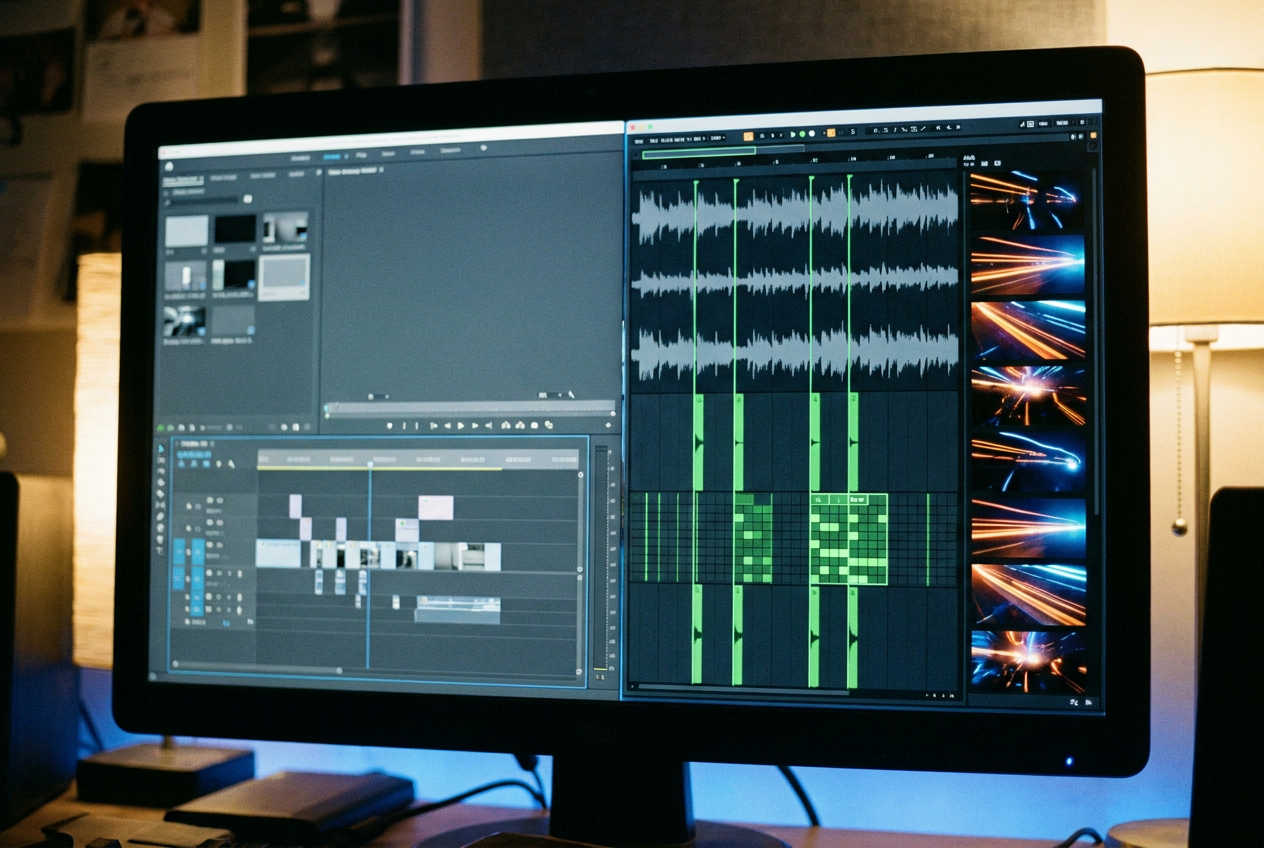
The category has split into two camps. Song-first tools react to your track and generate a complete music video in one pass. Creative video systems give you control over every scene, reference, and edit, and you assemble the video in stages.
Song-First Tools
These platforms start with your audio. You paste a link from SoundCloud, Suno, Udio, or YouTube, and the AI analyzes the full song structure — BPM, energy curve, section boundaries, vocal timing — before generating a single frame. The output is a complete, beat-synchronized music video.
This is the approach taken by tools like OneMoreShot.ai and Freebeat, where the music drives every visual decision. These generators analyze BPM, lyrics, and song structure to create rhythm-synced visuals automatically.
The experience is radically different from generic video generation. Music videos require different workflows. A filmmaker might begin with a storyboard and build scenes around it. A musician starts with a song. The visuals need to support the music rather than the other way around.
Visual-First Tools
Platforms like Runway Gen-4 and Kling 3.0 produce stunning cinematic footage — arguably the best-looking AI video available today. Runway delivers the most visually impressive AI-generated clips tested, with strong motion consistency and natural lighting. However, Runway has no built-in beat detection, no music analysis pipeline, and no audio-aware editing.
The tradeoff? You’re essentially a film editor assembling a puzzle. Runway’s Gen-4 model sets the benchmark for per-clip visual fidelity, with Director Mode controls over camera movement, framing, and lighting. It’s the go-to when individual shots need to look cinematic — but it has zero music awareness and cannot sync anything to a beat. You generate isolated 5–10 second clips and then edit and sync them yourself in a separate tool.
For a three-minute music video, that’s potentially 18–36 individual clips to generate, curate, and manually sync. No beat sync, short clips, subscription plus heavy credit cost ($100–$200+ for a full video), 5–15 hours of manual assembly, character drift across clips.
If you enjoy editing and have a clear cinematic vision, this can produce extraordinary results. If you need a video for your single by Friday, it’s a nightmare.
Why This Split Matters for Musicians
The category split isn’t just an industry taxonomy exercise. It has real implications for how you spend your time and money.
The Cost Math Changed
Where a basic 3-minute music video previously required $15,000–$50,000 budgets, AI tools now deliver comparable quality for $300–$1,200. But that range depends heavily on which type of tool you use and how much of your time you value.
Using a song-first tool, you can go from finished track to finished video in under an hour. Using a visual-first tool, you might produce higher-fidelity individual shots, but the total time investment (generation + editing + syncing) can stretch to 5–15 hours even with experience.
For context, AI lowers cost per video from $500–$2,000 to $20–$100 when you’re using purpose-built music video tools. That’s a game-changing number for independent artists, and it’s exactly why adoption has exploded.
Adoption Is Accelerating Fast
The numbers tell a clear story. 79% of SoundCloud artists surveyed by FAD now regularly use AI video generators, up from 12% just 18 months prior. That’s not a trend — that’s a paradigm shift.
Studies show that by 2026, over 60% of independent music videos on YouTube utilize some form of generative AI in their production pipeline. And the AI-generated video market is expected to grow by 35% annually, reaching $14.8 billion by 2030, with 54% of major artists already using AI visuals.
The artists who aren’t creating visual content for every release are becoming algorithmically invisible. Platforms like TikTok and YouTube Shorts have made visual content the primary discovery mechanism for new music, and artists who release audio-only are increasingly invisible in algorithmic feeds.
What Musicians Actually Need
After reviewing what multiple testing teams found, the features that separate real music video tools from general video generators are surprisingly specific:
Beat synchronization: Not just “reacting to volume” but understanding actual song structure. The most advanced 2026 music video generators incorporate AI vocal analysis to match visuals with emotional tone. A sad vocal passage might automatically trigger cooler color palettes and slower motion, while an energetic chorus could generate particle effects and dynamic camera movements.
Character consistency: Your lead character needs to look the same across every scene. This is where generic tools consistently fail for music videos, since each generation is independent.
Lip sync: Lip sync has become increasingly important for artists creating performance-style videos. Modern platforms can generate singing characters that follow lyrics with reasonable accuracy. However, quality varies significantly across tools.
Full-song support: Most generic AI video tools max out at 10–15 second clips. Musicians need 3–5 minute continuous videos. Artists releasing singles or albums usually need videos lasting several minutes. The best AI music video generation services support complete song workflows rather than isolated scenes.
Multi-format export: Music video distribution in 2026 is a multi-format reality. An artist releasing a single needs a widescreen version for YouTube, a vertical cut for TikTok and Instagram Reels, and potentially a square crop for other platforms.
If you’re exploring what these tools can actually produce across different genres, check out our guides on AI music videos for hip-hop, AI music videos for EDM, and AI music videos for indie — each genre has distinct visual language that the best tools now understand.
The Quality Gap Is Closing — But Not Gone
Here’s where I have to be honest. Where 2024 outputs often suffered from uncanny valley effects, 2026 generators produce fluid human-like movements and context-aware scene transitions. Cybernews’ June 2026 analysis found that 89% of viewers couldn’t distinguish AI-generated brand videos from human-produced equivalents in blind tests.
That said, we’re not at “replace your director” quality for every use case. AI-generated music videos are more than good enough for social media, streaming platforms, and promotional use. They’re approaching good enough for official releases in most genres. And for genres with strong visual-effects traditions — EDM, K-pop, sci-fi themed metal — they can actually be more interesting than what a modest traditional budget could produce.
The smart approach in 2026 is hybrid. Use AI music video templates for consistency and speed, then invest traditional production budget in one or two hero moments per album cycle. Our complete guide to AI music videos breaks down exactly how to balance AI and traditional production across a release campaign.
How to Pick the Right Tool for Your Workflow
The category is still young enough that there’s real variation between platforms. Here’s a practical framework:
If you need a finished video fast — go song-first. Upload your track to OneMoreShot.ai or a similar music-native tool. You’ll have something release-ready in minutes, with beat sync and character consistency handled automatically. For a step-by-step walkthrough, see our guide on how to make an AI music video.
If you have a specific cinematic vision — go visual-first with Runway or Kling, but budget 5–15 hours of assembly work and set aside credits for the inevitable re-generations. This approach works best when you have editing skills or a collaborator who does.
If you’re releasing frequently — song-first tools win overwhelmingly. AI music video generators collapse the production bottleneck. An artist can generate a first draft of a music video within minutes of finalizing a mix, iterate on the visual direction based on what the AI produces, and have a release-ready video before the track even clears distribution review.
If you make EDM, lo-fi, or ambient music — consider abstract/reactive tools like Neural Frames alongside song-first generators. Audio-reactive visualizers are genuinely excellent for electronic genres, and they serve a different purpose than narrative music videos. Check our AI music video examples for EDM and AI music videos for lo-fi for inspiration.
What Happens Next
This category split is only going to deepen. The general-purpose tools will keep chasing cinematic quality. The music-specific tools will keep building deeper audio intelligence. And the gap between “tools that understand music” and “tools that generate pretty video” will become impossible to ignore.
The barrier to entry just got lower; the bar for taste did not. That’s the real takeaway. The tools are democratized. The taste isn’t.
The musicians who win in this new landscape aren’t the ones with the biggest budgets or the most technical AI skills. They’re the ones with the clearest creative vision — who know exactly what they want their music to look like, and use these purpose-built tools to get there fast.
Every track deserves a visual. The tools to create them exist right now. The only question is whether you’re going to use them.
Ready to turn your next track into a music video? Try OneMoreShot.ai — paste your song link, and get a beat-synced, character-consistent music video in minutes. No editing experience required. No production crew needed. Just your music and your vision.