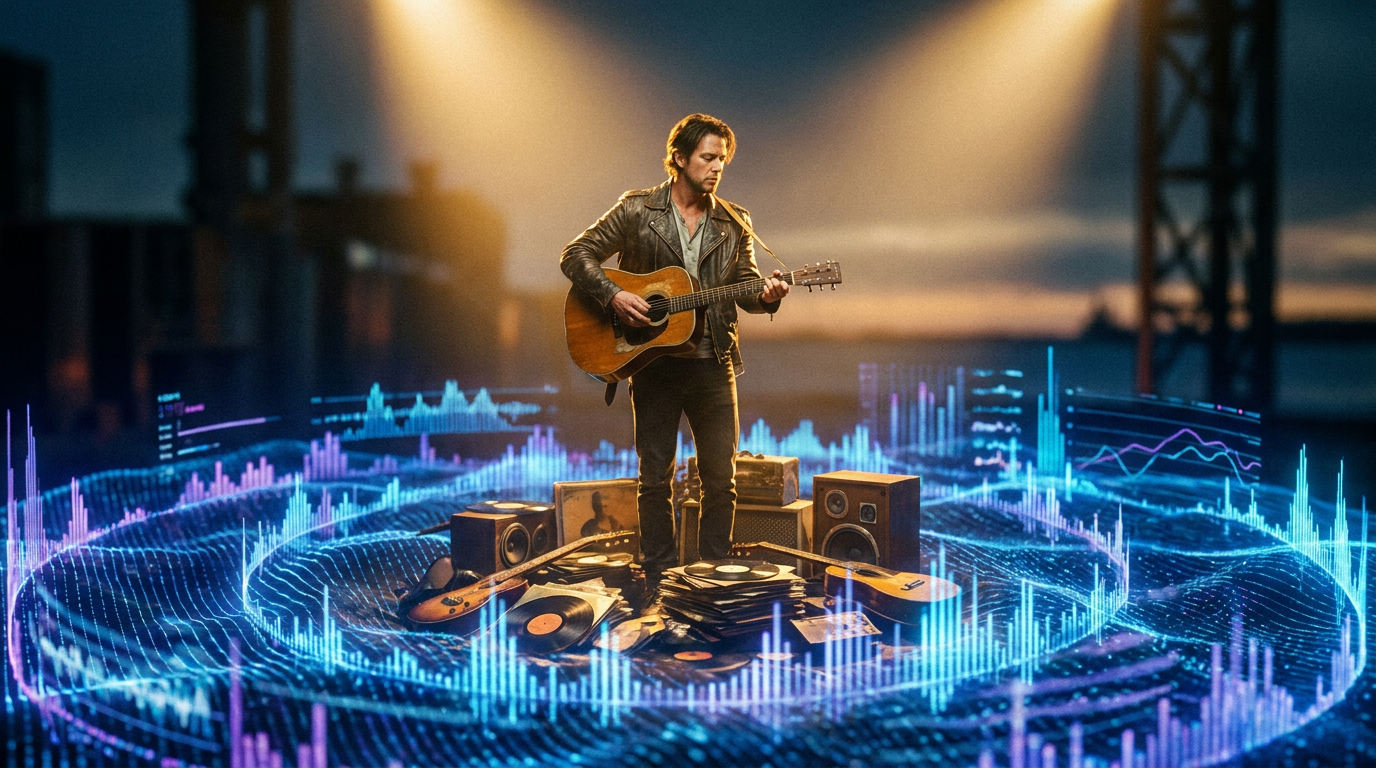
How Real Musicians Are Surviving the AI Music Flood
Here’s a number that should make every independent musician sit up straight: 44% of all new music uploaded to Deezer every single day is now fully AI-generated.
Deezer is now receiving almost 75,000 AI-generated tracks per day, representing roughly 44% of the daily uploads.
This amounts to more than 2 million AI-generated tracks uploaded per month.
And the growth curve is genuinely alarming. The new figures mark a sharp escalation from the 60,000 tracks per day the company reported in January, which was up from 50,000 in November, 30,000 in September, and just 10,000 when it launched its AI detection tool in January 2025.
That’s a 7.5x increase in 16 months. And Deezer is just the platform honest enough to measure it.
So the question for every musician reading this isn’t whether AI music is flooding your lane. It’s how you survive — and even thrive — inside the flood.
The Flood Is Mostly Fraud (But It Still Hurts You)
Here’s the silver lining nobody talks about enough: most of this AI music isn’t competing with you for fans. It’s competing with you for money.
Thanks to Deezer’s industry-unique measures, consumption of AI-generated music on the platform is still very low, between 1-3% of the total streams. In addition, a majority (85%) of these streams are detected as fraudulent and are demonetized by Deezer.
Read that again. The AI tracks are getting uploaded in massive quantities, but almost nobody is actually listening to them — and when they do, most of those “listeners” are bots. It’s a streaming fraud operation at industrial scale, using AI to generate the tracks and bots to generate the streams.
The damage is real, though. Artists and advocates have raised concerns about how a spike in AI content on streaming services can affect how much real musicians get paid, because Spotify, Apple Music and several other companies rely on a pro rata model — if an artist’s catalog accounts for a certain percentage of total streams on the platform, that’s the percentage of total royalty payouts they receive.
Every fake stream from a bot-played AI track dilutes the pool that pays you. According to a study conducted by CISAC and PMP Strategy, nearly 25% of creators’ revenues are at risk by 2028, which could amount to as much as €4 billion by that time.
The Platforms Are Finally Fighting Back (Sort Of)
To their credit, the major platforms are no longer pretending this isn’t happening. The last few weeks alone have seen a flurry of defensive moves:
Deezer remains the furthest ahead. Alongside the new data, Deezer has announced a fresh operational measure: the platform has now stopped storing hi-res versions of AI-generated tracks. They’ve effectively downgraded AI music to second-class content status.
YouTube just took two significant steps. Starting in May 2026, they’re rolling out new internal signals to help identify AI-generated content. If a creator doesn’t specify whether or not they used AI, but their systems detect significant photorealistic AI use, they will now automatically apply a label. No more honor system.
UMG and TikTok renewed their licensing agreement with teeth. UMG and TikTok recently announced the renewal of their licensing agreement, which includes a commitment to get rid of unauthorized AI-generated music from the platform. UMG stated the agreement “extends TikTok and UMG’s groundbreaking commitment to AI protections that promote human artistry.”
Spotify introduced Artist Profile Protection, letting artists review releases before they go live on the platform, after months of artists complaining about AI tracks appearing on their profiles. Spotify stated that “the rise of easy-to-produce AI tracks has made the problem worse.”
And Sony Music isn’t messing around either. Sony Music Entertainment revealed in March 2026 that it had asked streaming platforms to take down more than 135,000 songs created by fraudsters using generative AI to impersonate its artists.
Listeners Don’t Actually Want AI Music
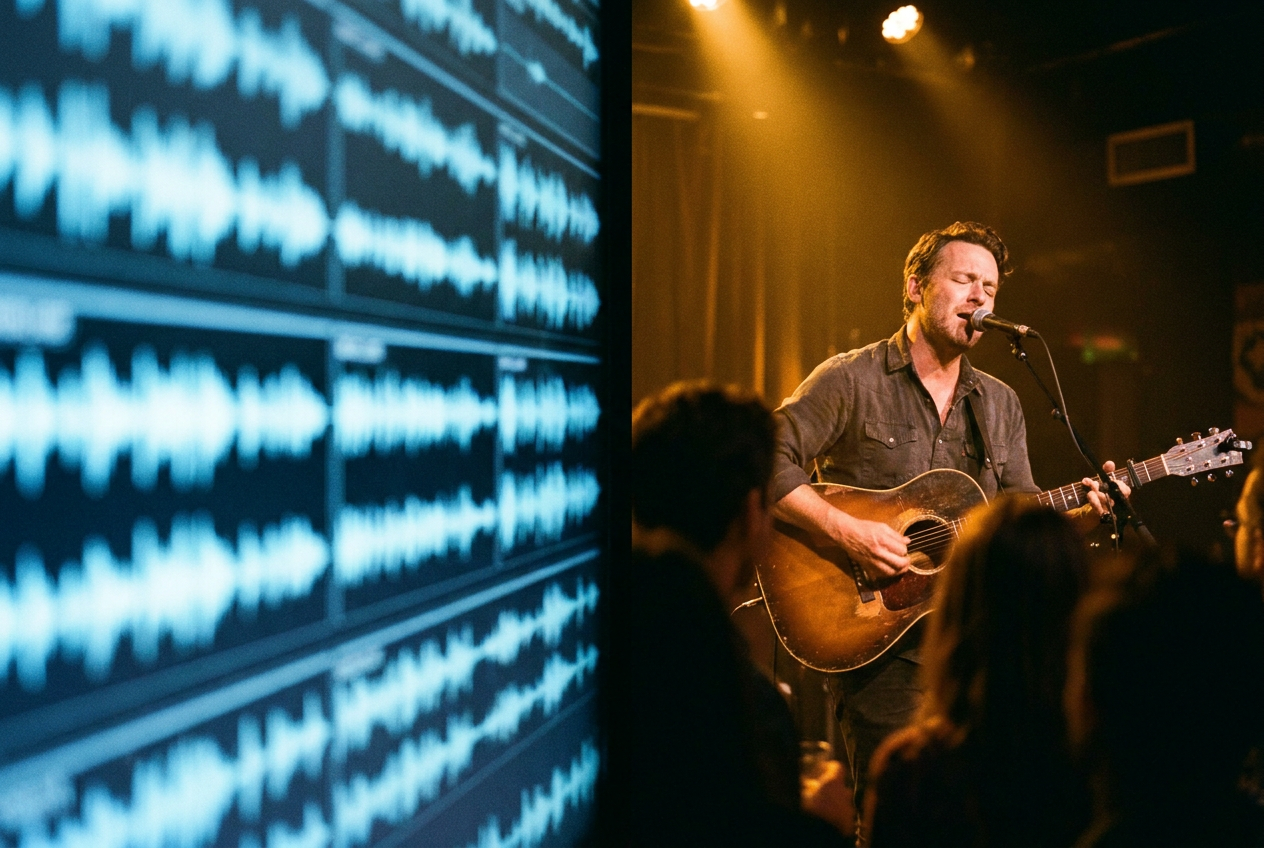
Here’s the data point that should give every real musician hope. Luminate’s report found that “across the board, consumers are net negative” toward AI music. “All that means is that people are more likely to feel uncomfortable than to feel comfortable with AI use.”
The study compared attitudes towards AI use in music creation from May to November of 2025 and found that overall interest dropped from -13% to -20% during that time period.
And here’s the kicker: Deezer’s own international study revealed that 97% of people couldn’t hear the differences between AI and human-made music, and that 80% of people agree that 100% AI-generated music should be clearly labeled to listeners.
So people can’t tell the difference by ear — but they still don’t want it. That’s not a technical problem. It’s an emotional one. People want to connect with other humans through music. They want the story, the struggle, the person behind the sound.
Which brings us to the real opportunity.
Why Music Videos Are Your Anti-Flood Weapon
In a world where anyone can generate a competent-sounding track in 30 seconds, what can’t be faked? The answer: you. Your face. Your story. Your creative vision rendered into visuals that connect your music to something real.
This is exactly why AI music videos — the ones made by real musicians, not for AI-generated music — have become the most powerful authenticity signal in the industry. An AI-generated track with no video is ambient noise. A human-written song with a compelling music video is art with a face attached.
The irony is beautiful: AI video tools are the best weapon real musicians have against AI music. Check out our complete guide to AI music videos to understand the full landscape.
Here’s why the math works in your favor:
-
Music videos create identity. Every major genre — from hip-hop to indie to EDM — has visual conventions that tell listeners “a real artist made this.” AI music scammers almost never bother with videos because they’re optimizing for volume, not connection.
-
YouTube rewards video over audio-only. A track on Spotify is one of 100 million. A music video on YouTube is a piece of content that YouTube’s algorithm actively promotes, suggests, and rewards with ad revenue at rates that dwarf per-stream payouts.
-
Videos are shareable proof of humanity. When someone shares your music video on Instagram or TikTok, they’re sharing you — not just a sound.
The New AI Music Tools (And Why They Matter Less Than You Think)
Meanwhile, the AI music generation race is getting more crowded by the day. ElevenLabs just released Music v2, a significantly upgraded AI music-generation model capable of shifting genres mid-track — moving from opera to heavy metal and back — while maintaining vocal coherence.
Crucially, ElevenLabs said the model was trained exclusively on licensed data and cleared for commercial use — a pointed distinction from rivals Suno and Udio, both facing copyright lawsuits from major labels.
Believe is partnering with Google to offer Flow Music — formerly known as ProducerAI — to its artists, producers, and songwriters as a “creative collaborator.”
And YouTube launched an AI tool that allows creators to replace copyrighted audio in videos with automatically generated instrumental tracks, adding a “Create” button to the existing “Replace Song” tool in YouTube Studio that generates four royalty-free instrumental options.
These tools are impressive. But here’s what nobody in the AI music hype cycle wants to acknowledge: generating music has never been the hard part of being a musician. The hard part is building an audience that cares. The hard part is being memorable. The hard part is standing out when 75,000 new AI tracks hit streaming platforms every single day.
That’s a marketing problem, not a music production problem. And it’s a problem that music videos solve better than anything else.
The Real Musician’s Playbook for 2026
So what should you actually do? Here’s the playbook that’s working for independent artists right now:
1. Make Every Release Visual
Stop thinking of music videos as optional bonus content. In the flood era, a song without a video is a song without a face. Learn how to make an AI music video and create at least a visual for every single and EP track.
2. Use AI for Visuals, Not as a Crutch for Music
The artists winning right now use AI to make their human-created music look incredible — not to replace their creative process. Tools like OneMoreShot.ai let you create stunning visuals from your existing tracks in minutes, giving you the visual firepower of a major-label artist without the major-label budget.
Whether you’re making R&B, rock, or lo-fi, there’s a visual language for your genre that you can tap into immediately.
3. Lean Into Transparency
A peer-reviewed study published in March found that listeners engage less deeply with music labeled as AI-generated — even when the music was actually human-composed. The label matters. So be aggressively, proudly human. Put “written and performed by a human” in your descriptions. Show your recording process. Make it clear that your music comes from lived experience.
4. Diversify Off Streaming
The pro rata model that lets AI slop dilute your royalties? You don’t have to play that game exclusively. YouTube music videos generate ad revenue independently. Sync licensing is booming — at Music Biz 2026, sync licensing dominated networking and discussions, with companies like Counterfight using technology to scan every social media platform to identify unlicensed music use by businesses.
5. Build a Visual Library, Not Just a Discography
The most future-proof musicians are building catalogs of visual content alongside their audio catalogs. Every song gets a video. Every video becomes a social asset. Every social asset drives fans back to your music. It’s a flywheel that AI music scammers can’t replicate because they’d need to create 75,000 unique visual identities per day.

The Future Belongs to Real Artists With Smart Tools
The AI music flood isn’t going to stop. The tools are too cheap, the volume too easy to generate, and the financial incentives for fraud too tempting. Nearly half of all music uploaded to Deezer every day is now AI-generated — a figure that has quadrupled in just over a year.
But here’s what the data also tells us: The hype around AI music isn’t entirely fake — several self-disclosed AI projects, including Xania Monet and Breaking Rust, have already landed on the Billboard charts. Even those successes prove the point: they worked because they had identity. They had a story, a visual presence, a reason to care.
The musicians who will thrive in 2026 and beyond aren’t the ones who pretend AI doesn’t exist. They’re the ones who use AI tools strategically — to create visuals, to scale their marketing, to do the production work that used to require a six-figure budget — while keeping their music, their identity, and their story unapologetically human.
The flood is here. But floods don’t destroy everything. They just change where the high ground is.
Ready to claim yours? OneMoreShot.ai turns your music into stunning AI-generated music videos in minutes — giving you the visual edge that separates real artists from synthetic noise. Try it free today.