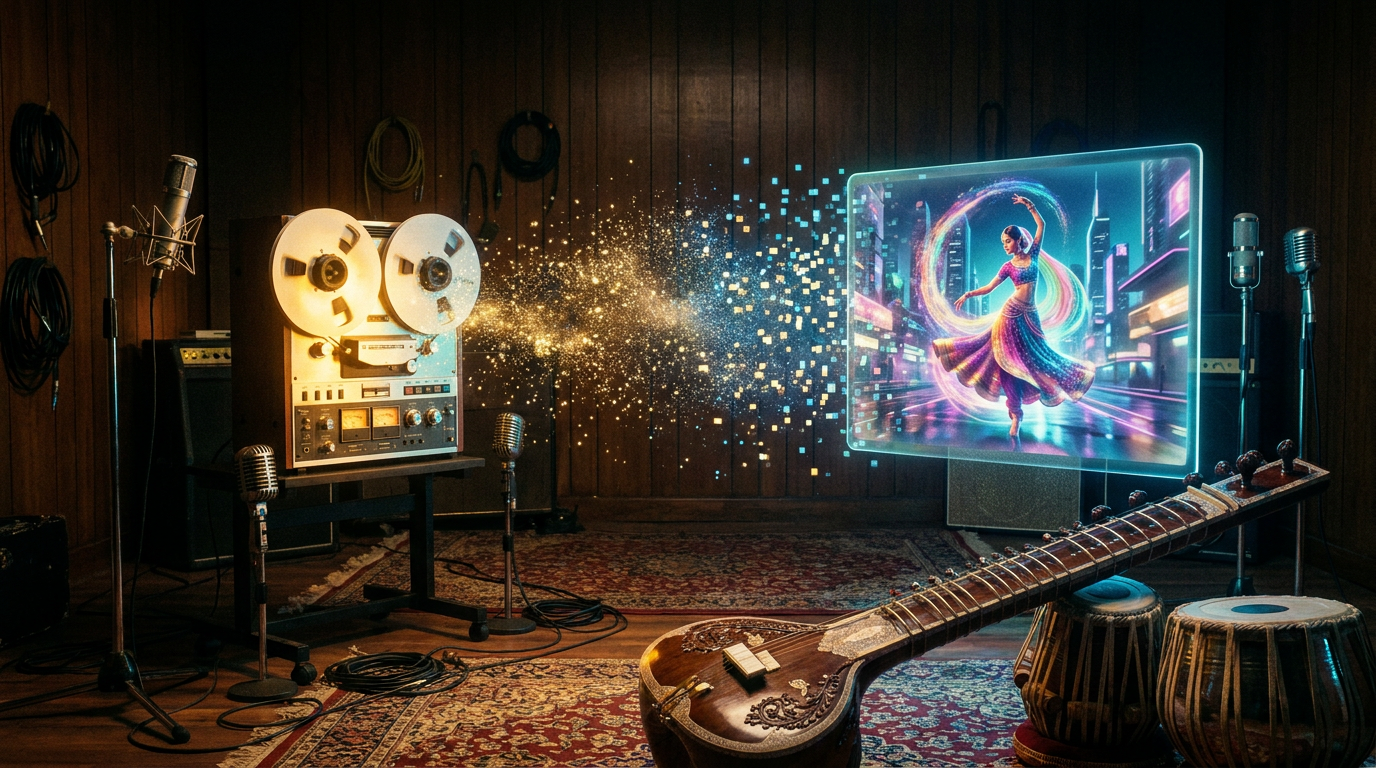
India's Oldest Label Is Using AI to Refilm 20,000 Songs
You’ve got songs. Maybe dozens. Maybe hundreds. They sit on Spotify, on SoundCloud, on a hard drive you haven’t opened since 2023. Every one of them deserves a music video. None of them have one.
You’re not alone. Saregama — India’s oldest music label, founded in 1901 — has the same problem. Just at a slightly different scale.
They own 87,000 songs. And most of them have never had a music video.
Now they’re using AI to fix that, and the playbook they’re building is one every independent musician should steal.
A 125-Year-Old Label Meets Generative AI
Saregama’s history stretches back over a century to 1901. Formerly known as The Gramophone Company of India Ltd. and more popularly as HMV (His Master’s Voice), the label was established as the first overseas Indian branch of EMI, London. From producing the first song recorded in India in 1902 to creating strong inroads into cinema, television, digital retailing, and events, Saregama has evolved into one of India’s premier entertainment content companies.
Their catalog is staggering. With a library boasting over 87,000 songs, the company sees immense potential in monetizing this content across digital platforms, particularly YouTube.
But here’s the twist that matters: the older catalog that Saregama owns — they own all the rights connected to the song except the rights of the original music video.
These were movies from the ’60s and ’70s. The original film footage belongs to the movie studios, not the label.
So Saregama had thousands of beloved songs — some of the most iconic recordings in Indian music history — but legally couldn’t use the original Bollywood visuals that audiences associate with them. For decades, that meant the songs lived as audio-only on streaming platforms, invisible in the visual-first era of YouTube, Instagram Reels, and TikTok.
Until now.
The $830 Music Video
During their Q1 FY27 earnings call in August 2026, Saregama’s Managing Director Vikram Mehra explained: “We have been trying to create brand new music videos, but the incremental cost of actually shooting a music video is not making sense. With AI, we are now reaching a position that a very true to real video can now be created at a very low cost, which may start making financial sense. If that experiment works, you literally can do both the things: create brand new videos with the original audio to talk to Gen X, giving them more contemporary-looking videos.”
The cost? As low as INR 70,000 per video — roughly $830 USD. Compare that to a traditional music video shoot in India, which can run $5,000 to $50,000+, and you start to understand why Saregama’s board is grinning.
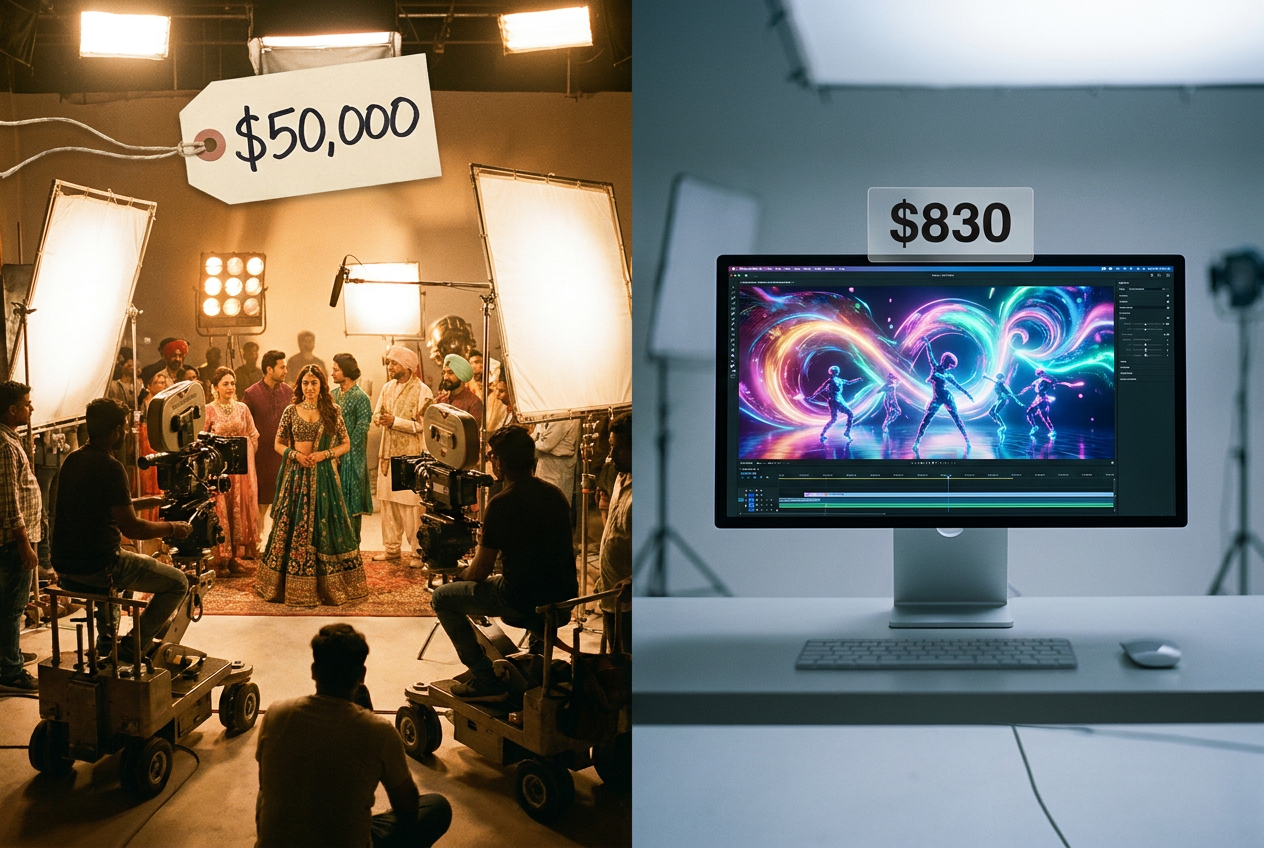
The ambition is enormous. The music giant plans to invest ₹200 crore to convert 20,000 of its top songs into AI-generated videos, a move aimed at creating a new revenue stream and modernizing its extensive catalog.
And they’re moving fast. Saregama aims to produce approximately 1,000 videos in the coming three to four months, projecting cost reductions of up to 70% and an 80% improvement in turnaround times.
Let that sink in: 1,000 music videos in four months from a single label. That’s roughly eight videos per working day. This isn’t a side experiment — it’s an industrial-scale AI video operation.
Why This Matters for Every Musician
Here’s what most independent artists miss: Saregama’s problem is your problem.
You probably have songs sitting on streaming platforms right now with no visual companion. In 2026, that’s a death sentence for discovery. YouTube is the world’s second-largest search engine. TikTok and Instagram Reels are the primary music discovery channels for listeners under 30. If your song doesn’t have a visual, it doesn’t exist for millions of potential fans.
Saregama’s SVP of music, Kartik Kalla, put it plainly: “The idea is to maximize reach across YouTube, Meta, and all major platforms.”
That’s not a label strategy. That’s a universal truth. Every song you own that doesn’t have a video is leaving streams, subscribers, and sync revenue on the table.
The difference is: Saregama has a ₹200 crore budget and a dedicated AI production team. You have… well, you have something even better. You have tools that didn’t exist 12 months ago.
The Indie Musician’s Version of This Play
Saregama is approaching this with dedicated AI content teams and enterprise-scale tooling. But the core strategy translates directly to independent artists. Here’s how to run the same play:
1. Audit Your Catalog
Go through every song you’ve released. How many have an official music video? A lyric video? Even a visualizer? If the answer is less than 100%, you have untapped visual real estate.
Saregama started with their most-streamed catalog tracks and devotional music — genres with proven audiences but no video assets. Companies like Saregama and Times Music are increasingly adopting AI technologies to enhance their existing song collections, notably by adding moving visuals to timeless audio tracks that previously lacked video components. The primary focus is on re-monetizing older songs, especially within genres like devotional music, which often had audio releases but no accompanying video.
You should do the same: start with your best-performing tracks. If a song already gets 10,000 monthly streams with no video, imagine what happens when you give YouTube’s algorithm something to recommend.
2. Match Visual Style to Genre
This is where AI music video tools shine. Different genres demand different visual approaches, and you don’t need a director’s reel to figure it out.
For a deep dive into what works for your specific sound, check out our genre-specific guides:
- Making hip-hop AI music videos that hit? The visual language is completely different from what works for country or jazz
- Latin music videos thrive on color, movement, and cultural specificity that AI tools now handle beautifully
- Indie artists have perhaps the biggest advantage here — the lo-fi, experimental aesthetic that defines the genre is exactly where AI video’s slightly dreamlike quality becomes a feature, not a bug
3. Think Volume, Not Perfection
This is the real lesson from Saregama. They’re not trying to create 20,000 Oscar-worthy short films. They’re building visual assets that make songs discoverable across platforms. Management said the company is experimenting with AI to create low-cost music videos and podcast-style content, but said the effort is still in an early stage.
The bar for “works on YouTube” is very different from “plays at Sundance.” A compelling AI-generated visualizer with consistent character and mood can outperform a static thumbnail by orders of magnitude.
Our complete guide to AI music videos in 2026 walks through the entire process, from choosing the right style to optimizing for each platform. If you’re sitting on five or ten unreleased songs without videos, start there.
4. Multi-Format Everything
Multi-format export — widescreen for traditional platforms, vertical for short-form social feeds, and square crops — addresses the fragmented distribution landscape of 2026, where a single release must perform across YouTube, TikTok, Instagram Reels, and other channels.
One song, multiple visual cuts. A full widescreen music video for YouTube. Vertical clips for Reels and TikTok. A square visualizer for X. This is what Saregama is building at scale, and it’s exactly what tools like OneMoreShot.ai make possible for indie artists in minutes.
The Bigger Picture: Catalog Is the New Frontier
Saregama’s move signals something larger happening across the music industry. Catalog has become the most valuable asset class in music — legacy songs generate reliable, growing revenue that new releases can’t match. But catalog has always had a visual gap.
Think about it: most of the world’s greatest songs were released before the music video era, or were released by artists who couldn’t afford a video. Elvis Presley, Johnny Cash, Bob Marley, Billie Holiday — countless iconic recordings exist only as audio.
Indian music labels like Saregama are leveraging Artificial Intelligence to revive their vast song collections. By using AI to create video content for older audio-only tracks, particularly in devotional genres, they are unlocking new monetization avenues on platforms like YouTube. This technology significantly cuts costs and turnaround times, breathing new life into timeless melodies and appealing to a wider, modern audience.
This isn’t just an Indian phenomenon. Every label in the world is sitting on vast catalogs of audio-only tracks. And AI video just made it economically viable to give every one of those songs a visual life.
For independent musicians, the math is even more compelling. You don’t need ₹200 crore. You need a few dollars and a few minutes per track.
What Saregama Gets Right (And What You Should Copy)
Let’s break down the strategic intelligence here:
They started with what they own. Saregama didn’t try to license new music or create original compositions. They looked at existing audio assets and asked: what’s missing? The answer was video. If you have songs, you already have the hard part done.
They chose AI because traditional costs don’t pencil. Mehra was direct: “We have been trying to create brand new music videos, but the incremental cost of actually shooting a music video is not making sense. With AI, we are now reaching a position that a very true to real video can now be created at a very low cost.” If a label with $24 million in quarterly revenue says traditional video production doesn’t make financial sense for catalog, it certainly doesn’t make sense for you either.
They’re targeting platform-specific distribution. It’s not just about making a video — it’s about making the right video for the right platform. YouTube long-form, Instagram vertical, Meta placement. Each format is a separate revenue and discovery channel.
They’re treating it as an ongoing process, not a one-time event. 1,000 videos in four months, scaling to 20,000. This is a content pipeline, not a campaign. The artists who win in 2026 are the ones who treat video as a continuous output, not a once-per-album event.
The Race Is Already On
Saregama isn’t the only one making this move. Companies like Saregama India Ltd and Times Music are increasingly adopting AI technologies to enhance their existing song collections and create new content, notably by adding moving visuals to timeless audio tracks.
Meanwhile, independent artists who move first get the same advantage. Your back catalog is your unfair advantage — you know these songs intimately, you know what visuals fit, and you can move faster than any label because you don’t need board approval.
If you want to learn how to make an AI music video, the process has never been simpler. Upload your track, describe your vision, and let the AI handle the rest. Whether you’re making pop, R&B, EDM, or metal, there’s a visual approach that works.
Your Move
Saregama is spending millions to solve a problem you can solve for a few bucks. Their 87,000 songs are getting AI music videos. Your 10 songs — or 50, or 100 — deserve the same treatment.
Every song without a video is a song that’s invisible on the platforms where fans actually discover music. That was an acceptable trade-off when videos cost $5,000 minimum. In August 2026, it’s just a missed opportunity.
The oldest music label in India figured this out. Now it’s your turn.
Start creating AI music videos for your catalog on OneMoreShot.ai →