
TIDAL's AI Music Ban Changes the Rules
Yesterday, TIDAL drew a line in the sand. And if you’re a musician using AI tools — in any capacity — you need to pay attention.
The music streaming service TIDAL announced a new policy that will prevent fully AI-generated music from making money on its platform. Not labeled. Not deprioritized. Demonetized. Fully AI-generated music will no longer be eligible for monetization, royalty collection, or direct-to-fan sales on its platform, effective July 15, 2026.
That’s just 15 days from now. And it’s not an isolated incident — it’s the latest (and arguably most aggressive) move in a coordinated crackdown across every major streaming platform. If you’re an independent musician navigating the AI landscape, the game just changed underneath you.
What TIDAL Actually Did
Let’s break down the specifics, because the details matter.
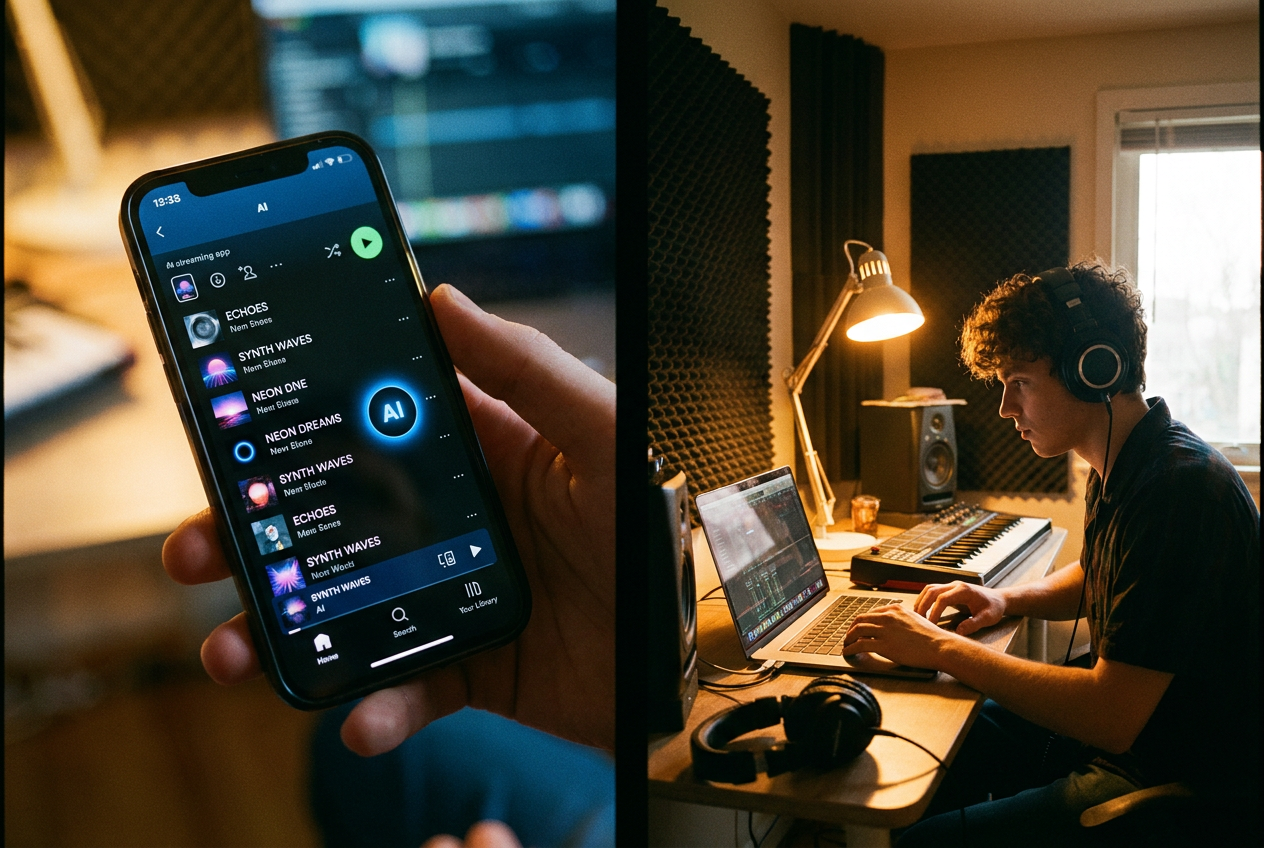
Fully AI-generated music on TIDAL will be identified and tagged as such, allowing listeners to see an “AI” badge next to any tracks deemed to be 100% AI.
These tunes will not be able to be monetized or collect royalties, and will not be eligible for direct-to-fan sales.
But it goes further than labeling and demonetization. TIDAL will use automated tools to remove AI-generated music that attempts to impersonate an artist or a group. And any AI music that exploits an artist’s voice or likeness will be taken down, and Tidal will immediately block tracks associated with fraudulent activity, which includes artificial streaming and deceptive content that interferes with real creators.
TIDAL will also ban AI-generated music associated with “fraudulent activity,” a category that includes songs impersonating established artists and efforts to “deceive listeners.”
Here’s the part that should make every AI-curious musician sit up: the policy also includes a forward-looking clause: as AI detection technology becomes more reliable, TIDAL will expand these restrictions to content that is “substantially” AI-generated, rather than just wholly AI-generated. Translation: today it’s 100% AI tracks. Tomorrow, it could be your track that used Suno for the backing vocals.
Why This Is Different From What Everyone Else Is Doing
You might be thinking: “Haven’t we seen this before?” Spotify labels AI music. Apple Music tags it. Deezer flags it. So what?
Here’s the crucial distinction: demonetization is a harder line than labeling. Every major platform so far has stopped at transparency. Tidal is the first to test whether removing the financial incentive actually reduces AI music volume.
That’s the experiment. And if uploads fall on Tidal after July 15 while remaining high on labeled-only platforms, it will give the industry a data point that changes the policy conversation at Spotify and Apple Music.
Let’s look at what the other platforms are currently doing:
Spotify updated its policy in September 2025. It adopted DDEX disclosure for AI use in credits and says it does not penalize or down-rank music for being AI-assisted. It bans unauthorized AI voice clones, deepfakes, and impersonation outright, and removed more than 75 million spammy tracks in the prior year.
Apple Music launched Transparency Tags in March 2026 across four categories: artwork, track audio, composition, and music video. Labels and distributors decide what counts as material AI use. For now the tags are self-reported with no visible automated enforcement.
Deezer has taken the most aggressive detection stance. Deezer is now receiving almost 75,000 AI-generated tracks per day, representing roughly 44% of the daily uploads.
The new figures mark a sharp escalation from the 60,000 tracks per day the company reported in January, when synthetic content represented 39% of daily deliveries. Their solution? Songs tagged as AI-generated on Deezer are automatically removed from algorithmic recommendations and not included in editorial playlists.
But none of them went as far as stripping royalties entirely. TIDAL just did.
The 44% Problem
Let’s sit with that Deezer stat for a moment, because it tells you why this is happening.
The daily AI upload figure marks a significant jump from the 50,000 AI tracks Deezer was receiving per day in November, 30,000 in September, and just 10,000 when it launched its patent-pending AI detection tool in January 2025.
That’s a 7.5x increase in 15 months. At that trajectory, AI-generated tracks will outnumber human-created uploads by the end of this year.
And here’s the kicker: consumption of AI-generated music on the platform is still very low, between 1-3% of the total streams. A majority (85%) of these streams are detected as fraudulent and are demonetized by Deezer.
So 44% of all new music is AI-generated, but only 1-3% of listeners actually want it. And 85% of even those streams are fake. This is the streaming economy equivalent of a city whose landfill grows faster than its population.
According to a study conducted by CISAC and PMP Strategy, nearly 25% of creators’ revenues are at risk by 2028, which could amount to as much as €4 billion by that time.
That’s the real story. This isn’t about platforms being anti-AI. It’s about protecting the royalty pool that actual musicians depend on.
The “Jacub” Problem: When AI Music Goes Viral
TIDAL isn’t acting in a vacuum. The streaming industry has been rattled by real-world incidents that proved this isn’t theoretical.
A pop-folk single became one of Sweden’s biggest tracks of 2026, garnering millions of streams and soaring to the top of the country’s Spotify chart. However, an investigation by Swedish journalist Emanuel Karlsten found that “Jacub” — the artist listed as the single’s creator — was actually a team of producers connected to music marketing company Stellar Music, two of whom reportedly worked for the firm’s AI department.
Following this revelation, IFPI Sweden said the single would not qualify for inclusion in its singles chart. The chart body’s CEO was blunt: songs that are “mainly AI-generated” don’t have the right to chart.
The track still has millions of streams on Spotify. It still earns royalties there. Spotify and other streaming platforms currently have no requirement that music created with AI be labeled as such. But the official charts refused it.
This is the gap TIDAL is trying to close: the space between platform availability and financial legitimacy.
What This Means for AI-Assisted Musicians
Here’s where it gets tricky — and where most of the hot takes are getting it wrong.
TIDAL’s policy targets music that is wholly AI-generated. Tidal defines AI-generated music as music that is wholly generated using generative artificial intelligence. Due to limitations in AI-detection technology, and to avoid false positives, they will only be taking action with respect to wholly AI-generated content.
The key word is “wholly.” If you’re a songwriter who uses AI to generate a demo, then records real vocals and plays actual instruments — you’re (probably) fine. If you use AI mastering or AI-assisted mixing — you’re definitely fine. If you type a prompt into Suno and upload the raw output — you’re not.
TIDAL’s new policy reads: “Artists should have the freedom to create with AI tools, and listeners should have the autonomy to choose the type of content they consume.”
But remember that forward-looking clause. As the reliability of AI-detection technology improves, TIDAL will expand actions to content that is substantially AI-generated. The line will keep moving.
Listeners will spot a special icon next to content that algorithms flag as 100% AI-generated starting mid-July, and the platform hopes to expand this tag to partially generated songs as detection tech improves.
The Smart Musician’s Playbook
So what’s the move? It’s actually pretty straightforward:
-
Keep your process documented. Save stems, session files, vocal takes. Proof of human involvement is your insurance policy. If your track gets falsely flagged, you’ll need evidence.
-
Don’t upload raw AI output anywhere. Even if you’re “just testing,” that track is now in a distributor’s pipeline with your name on it.
-
Use AI as a tool, not a replacement. The platforms are drawing the line at wholly AI-generated content. Keep humans in the loop — even if AI handles parts of the workflow — and you stay on the right side of every current policy.
-
Invest in visuals. This is the big one, and it’s where the opportunity actually lives.
Why Music Videos Are Your Best Hedge
Here’s the irony that nobody’s talking about: while streaming platforms crack down on AI music, AI-generated visuals face zero restrictions. No platform is demonetizing music videos because they used AI-generated imagery. No chart body is banning videos made with Kling 3.0 or Veo 3.1.
In fact, the opposite is happening. Labels using AI-generated music videos saw a 40% increase in engagement on social media compared to static album art. YouTube wants you to upload video content. TikTok wants your visual clips. Instagram rewards Reels with reach.
This is the asymmetry that smart musicians should exploit right now. Your music needs to be human-created (or at least human-directed with clear documentation). But your visuals? Go wild.
If you’re making original music and need visuals that match your creative vision, AI music video tools are the safest, most cost-effective play in 2026. The cost advantage is staggering: where a basic 3-minute music video previously required $15,000-$50,000 budgets, AI tools now deliver comparable quality for $300-$1,200.
Whether you’re in hip-hop, pop, indie, or country, the visual side of your release strategy is where AI gives you leverage without any platform risk.

The Bigger Picture: Human Premium vs. AI Scale
For the broader music industry, this move signals a growing “Human Premium.” As AI-generated hits flood charts and reach saturation, platforms like TIDAL are betting that the value of provenance and human connection will become the primary driver of consumer engagement.
This isn’t just TIDAL being precious about purity. It’s a business bet. TIDAL has always positioned itself as the artist-first, high-fidelity platform. Banning royalties is perhaps the most significant addition to the policy, as Tidal has typically paid artists more than competitors such as Spotify.
And TIDAL’s EVP Tony Gervino was remarkably direct: “Regardless of what you are reading elsewhere, AI’s takeover of the music industry (and your recommendations) isn’t inevitable if we take even greater steps now to monitor and control it.”
That’s a shot across the bow at Spotify’s more permissive approach. And it raises the question: will TIDAL’s experiment succeed? If demonetization actually reduces the flood of AI tracks — and makes the listening experience measurably better — pressure on Spotify and Apple Music to follow will be enormous.
What Comes Next
The streaming platform AI policies are rapidly diverging, but the direction is clear: more restrictions, not fewer.
EU AI Act Article 50 enforcement begins August 2, 2026. It requires machine-readable marking on all AI-generated video distributed to EU audiences. Penalties up to €15M or 3% of worldwide annual turnover.
Between TIDAL’s July 15 demonetization, the EU enforcement in August, and Deezer’s continued expansion of AI detection technology to other platforms, the window for uploading undisclosed AI music is closing fast.
The musicians who will thrive are the ones who understand the new rules: make your music genuinely human (or transparently human-directed), and use AI where it actually helps without regulatory risk — like creating stunning music videos that get your work seen on YouTube, TikTok, and Instagram.
The era of AI-generated music slipping quietly into streaming royalty pools is ending. The era of AI-powered music promotion — visual content, social clips, music videos — is just getting started.
Start Creating What Platforms Actually Want
The math is simple: platforms are restricting AI music while rewarding video content. If you’re an independent artist with real songs and no visual budget, the smartest investment you can make right now is a music video.
OneMoreShot.ai lets you turn your original tracks into professional music videos in minutes — no film crew, no $15K budget, no risk of platform demonetization. Whether you’re dropping a lo-fi track or a rock anthem, you get visuals that match your sound and help your music stand out in a streaming landscape that’s about to get a lot more competitive for human artists. Which is exactly the point.