Who Gets Paid in the AI Music Licensing Era
In the span of ten days, the AI music industry compressed an entire era’s worth of drama into a single headline reel. Suno raised $400 million at a $5.4 billion valuation. The musicians’ union sued Universal and Warner for cutting them out of AI deals. And the NMPA announced the first industry-wide publishing license with an AI company.
If you’re an independent musician wondering what all of this means for you — and specifically, whether anyone plans to pay you — buckle up. The answer is complicated, revealing, and probably not what the press releases want you to think.
The $5.4 Billion Elephant in the Room
On June 3rd, Suno officially closed its Series D. The round raised over $400 million at a $5.4 billion post-money valuation, led by Bond Capital alongside IVP, Forerunner, Union Square Ventures, Alkeon, and Quiet, with participation from existing backers Matrix, Lightspeed, Menlo Ventures, and Schroders Capital.
That’s not a typo. The funding more than doubles Suno’s valuation from the $2.45 billion it achieved after closing a $250 million Series C round just seven months earlier.
Total capital raised is now over $775 million.
To put that in perspective, Suno is now valued in the same neighborhood as some of the biggest names in generative AI across all categories — images, video, you name it. Music has historically been the hardest creative vertical for AI to monetize cleanly, precisely because of the rights questions that put Suno in court. And yet here we are.
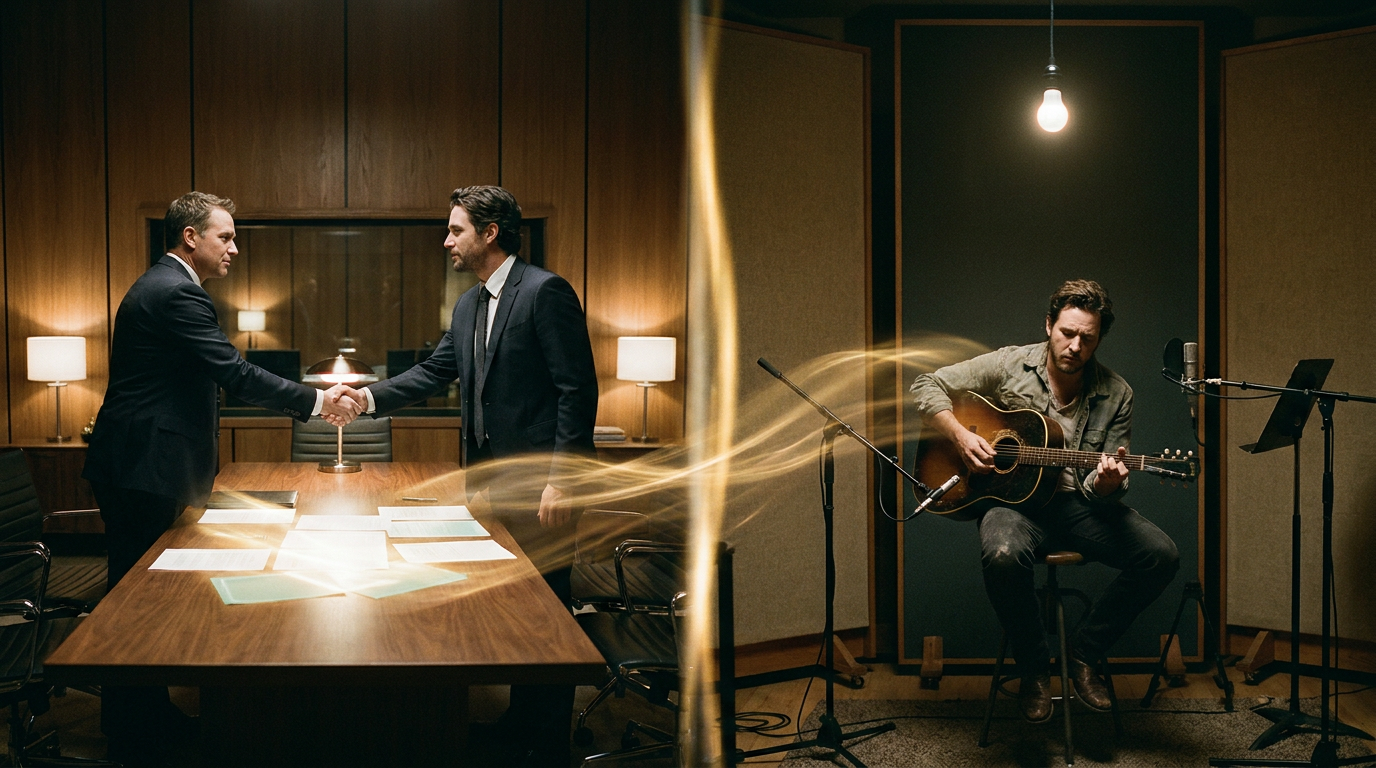
The result is a split-screen the music industry has never seen before: venture investors betting billions that Suno will win, and Universal, Sony, and Warner betting in court that it is built on infringement. Well, two of those labels, anyway. Warner settled its claims in November 2025, with terms that reportedly included a licensing partnership.
The irony is thick enough to spread on toast. The very same major labels that sued AI companies for threatening human artistry are now licensing their catalogs to those companies. And the humans who actually played on those recordings? They’re lawyering up.
Session Musicians Say: What About Us?
On June 5, 2026 — just two days after Suno’s massive raise — the American Federation of Musicians (AFM) sued Warner Music Group and Universal Music Group in Manhattan federal court, alleging that the labels licensed members’ work to AI companies for training without the musicians’ permission or compensation.
The timing was exquisite. The lawsuit landed while the ink was still metaphorically drying on Suno’s Series D announcement.
The complaint, spanning 16 relatively straightforward pages, names Universal Music and Warner Music — but not Sony Music, which hasn’t settled with Suno or Udio — as defendants.
Here’s the crux of it: the AFM contends those arrangements triggered the “new uses” provision of its collective bargaining agreement, which requires major labels to pay musicians when their work is put to new commercial applications.
And here’s the devastating rhetorical move. The AFM complaint smartly uses the labels’ own prior rhetoric against them: the labels described AI music generation as a threat to human artists and the music market; AFM now says the labels settled and licensed that same threat without sharing the benefits with musicians.
Think about that for a second. Universal and Warner spent 2024 arguing in court that Suno and Udio were destroying the music industry by training on copyrighted recordings. Then they turned around and licensed those same recordings to those same companies — and apparently forgot to tell the people who actually played the drums, bass, guitar, and keys on those tracks.
WMG called the lawsuit “unproductive” and said it looks forward to resuming scheduled negotiations, framing its Suno deal as part of a broader effort to “architect a healthy AI ecosystem on behalf of artists everywhere.” Universal, for its part, responded that it has been protecting artists and songwriters through responsible AI licensing, legislation, and litigation, and characterized the lawsuit as arising during collective bargaining negotiations.
The NMPA Deal: Publishers Get Their Seat
If the AFM lawsuit was the stick, the NMPA’s announcement five days later was the carrot — at least for publishers and songwriters.
During its Annual Meeting at Lincoln Center’s Alice Tully Hall on June 10, the National Music Publishers’ Association (NMPA) announced two industry-wide AI music deals with Udio and Klay Media.
This is genuinely significant. According to NMPA President and CEO David Israelite, the Udio deal is not only the first industry-wide licensing deal with a major AI company, but the first that will value songs and sound recordings equally when it comes to AI training.
That last part — “value songs and sound recordings equally” — is the money line. Historically in the music industry, sound recordings (owned by labels) have commanded far more licensing revenue than the underlying compositions (owned by publishers and songwriters). The NMPA deal says: not this time.
As Israelite explained: “There has been hesitancy to make mistakes in these early deals, but there has not been any deal offered across the entire market until today.”
The NMPA has struck template licensing deals for its members with AI platforms Udio and Klay, providing a model agreement independent music publishers can now opt into. Israelite stressed these “value songs and sound recordings equally.”
Meanwhile, the Klay deal is unique in that it is one of the few companies to secure licensing prior to launching its platform. Klay’s Large Music Model will be trained entirely on licensed music, and the deal with NMPA will launch later this summer.
Israelite said the deals sit alongside the NMPA’s continued litigation against AI companies it regards as bad actors. “Litigating against bad AI actors and licensing good AI partners is not in conflict,” he said.
And for the Nashville crowd, Israelite announced an upcoming “AI Songs Summit” in Nashville set for September for the publishing industry to convene and align on AI policy.
Udio’s Transformation: From Defendant to Licensed Partner
The arc of Udio’s journey is remarkable enough to deserve its own section. Udio has completed a shift from copyright defendant to licensed industry partner. In June 2024, the RIAA sued Udio and Suno for “mass infringement” of copyright. That litigation began to unwind in October 2025, when Universal Music Group settled and agreed to build a licensed AI music platform with Udio. Warner Music Group settled in November 2025, followed by Merlin in January 2026 and Kobalt in April 2026.
Sony Music remains the only major music company yet to reach a deal with Udio.
The new licensed platform, when it finally launches, will be a fundamentally different product. The platform will use generative AI models trained solely on licensed and authorized music, enabling fans to create remixes, covers, and original songs using the voices and compositions of participating artists and songwriters.
So we’ve gone from “you’re destroying music” to “let’s build a product together” in roughly 18 months. The music industry moves slowly — until it doesn’t.
What This Actually Means for Independent Musicians
Here’s where it gets personal. If you’re an indie artist reading this and wondering how any of these billion-dollar deals affect you, the honest answer is: it depends on what you do next.
The Good News
The AI licensing infrastructure is actually being built. The NMPA template deals mean that even small publishers can opt into revenue from AI training. The NMPA said that deals negotiated and settled in the past fiscal year, including those AI deals, have led to the distribution of approximately $110 million to its members. That’s real money flowing to real songwriters.
The principle of equal valuation for songs and recordings is being established early. If this holds, songwriters won’t get the short end of the stick the way they have with streaming.
The Bad News
Session musicians — the people who literally play on the records — are being left out. If you’re a touring guitarist who played on a major-label album, your performance may be training an AI model right now, and nobody’s cutting you a check. That’s what the AFM lawsuit is about, and it could take years to resolve.
And if you’re a fully independent artist who isn’t signed to a publisher affiliated with the NMPA? These deals don’t cover you. Yet.
The Practical Move
This is the era where what tool you use matters as much as what you create. The safest long-term path is still to build your own sound. Licensed remix lanes may grow, but unauthorized imitation will become harder to defend.
For music videos specifically, the equation is actually cleaner. While the music rights world is a tangled web of competing claims, AI video generation for your own music is straightforward — you own your track, and you’re creating new visual content to support it. Nobody’s suing anyone over AI-generated visuals set to your original songs.
That’s why tools like OneMoreShot.ai exist in a sweet spot. You bring your own music. The AI creates visuals for it. No licensing ambiguity. No rights disputes. Just your song with a music video that would have cost you $10K-$50K a few years ago.
The Bigger Picture: Three Lanes Are Forming
If you zoom out from the chaos of this particular week, a clear pattern emerges. The AI music world is sorting itself into three distinct lanes:
Lane 1: Fully Licensed AI Platforms. Udio (post-settlement), Klay, and eventually Suno (if it settles with Universal and Sony) will operate as licensed services where every note in the training data has a paper trail. These platforms will likely cost more, have more restrictions, and produce output that’s legally defensible. Think of them as the Spotify of creation.
Lane 2: The Legal Battlefield. Suno is fighting on fair-use grounds in the U.S. District Court for the District of Massachusetts, where a key summary-judgment hearing is scheduled for July 2026. Whatever happens in that courtroom could redefine copyright for a generation. Sony is still in litigation with Udio. The AFM lawsuit adds another front. This lane is messy and expensive.
Lane 3: Visual AI for Musicians. This is the lane that has nothing to do with music copyright at all. AI video generation tools — the ones that help you make a music video from your existing tracks — sit completely outside the music licensing wars. Whether you’re making a hip-hop video, an EDM visual experience, or an indie aesthetic piece, you’re creating new visual content. That’s a purely additive creative act.

The Proof Era Has Arrived
AI music creators are entering the proof era. Not just proof that a song sounds good. Proof of process. Proof of rights awareness. Proof of human direction. Proof of metadata. Proof that the creator is not just flooding platforms with disposable AI output.
This is the new reality. Platforms, labels, publishers, and unions are all demanding receipts. Where did the music come from? Who played on it? Who gets paid?
For independent musicians, this isn’t a crisis — it’s a competitive advantage. You are the human. You did play it. You can prove your process. The AI tools you layer on top — whether for production, mixing, mastering, or creating stunning visuals for your tracks — are enhancements to a human-directed creative vision.
What to Watch Next
The next few months are going to be wild:
- July 2026: Suno’s summary-judgment hearing could determine whether AI training on copyrighted music is fair use. This is potentially the most important copyright case in decades.
- Summer 2026: Klay’s licensed platform launches with its fully-licensed Large Music Model. We’ll finally see if “licensed from day one” produces better results than the “train now, ask permission later” approach.
- September 2026: The NMPA’s AI Songs Summit in Nashville will bring together songwriters, publishers, and streaming services. Expect policy announcements.
- Ongoing: The AFM lawsuit will proceed, and its outcome could force labels to retroactively compensate session musicians for AI licensing deals. This could cost hundreds of millions.
The Bottom Line
The music industry isn’t fighting about AI anymore. It’s fighting over AI. Over who controls it, who profits from it, and who gets left behind.
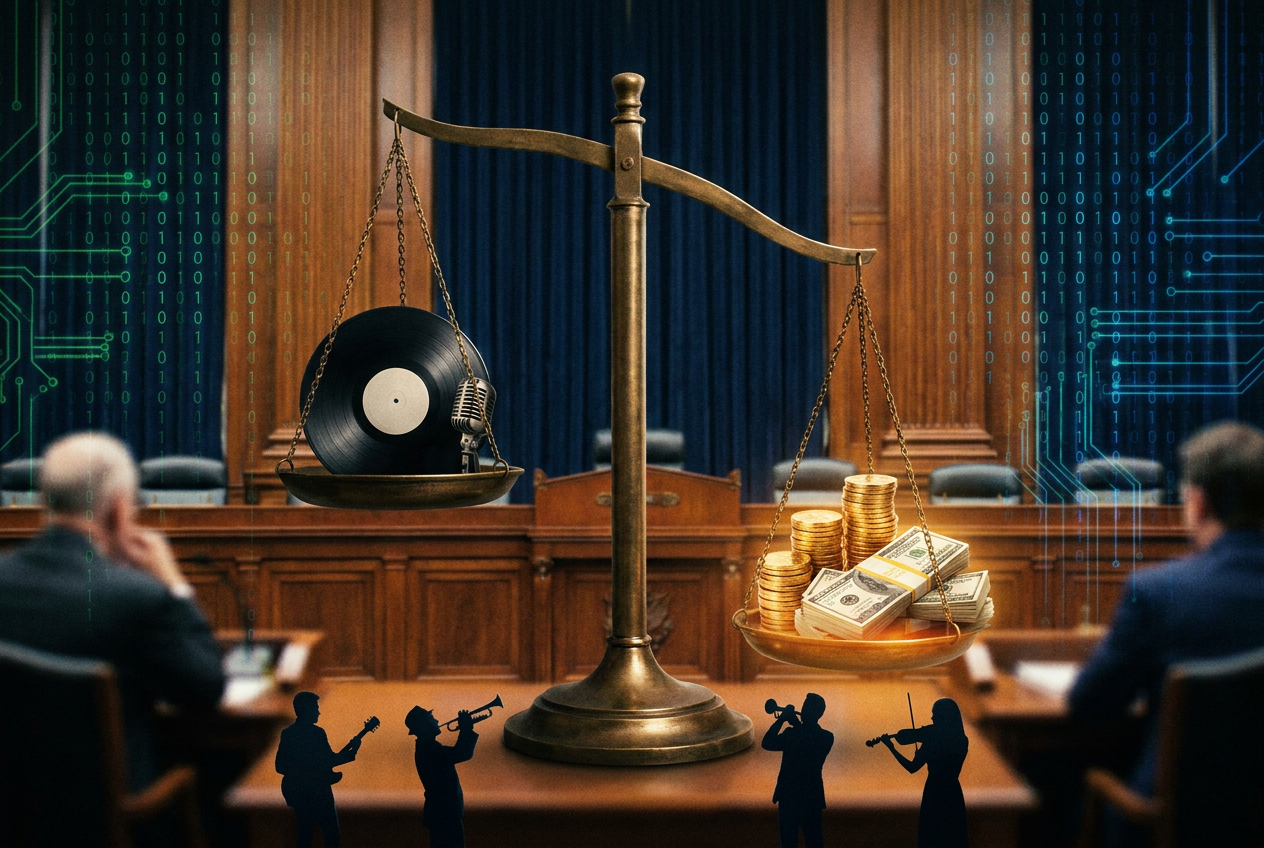
Labels are positioning themselves as gatekeepers. Publishers are demanding equal pay. Session musicians are demanding any pay at all. AI companies are raising billions. And independent artists are… watching from the sidelines?
Don’t be a spectator. The tools available to you right now are extraordinary. You can create professional-quality music videos for your rock tracks, lo-fi visual loops, or Latin music videos without waiting for anyone’s permission or licensing deal.
The AI music licensing wars will rage on. Lawyers will bill millions. Executives will give speeches about “architecting healthy ecosystems.” But while they’re all fighting over the past — over who gets paid for what was already recorded — you can be building the future.
Your music. Your visuals. Your terms.
Start creating your AI music video today at OneMoreShot.ai →