AI Music Now Floods 44% of Streaming Uploads
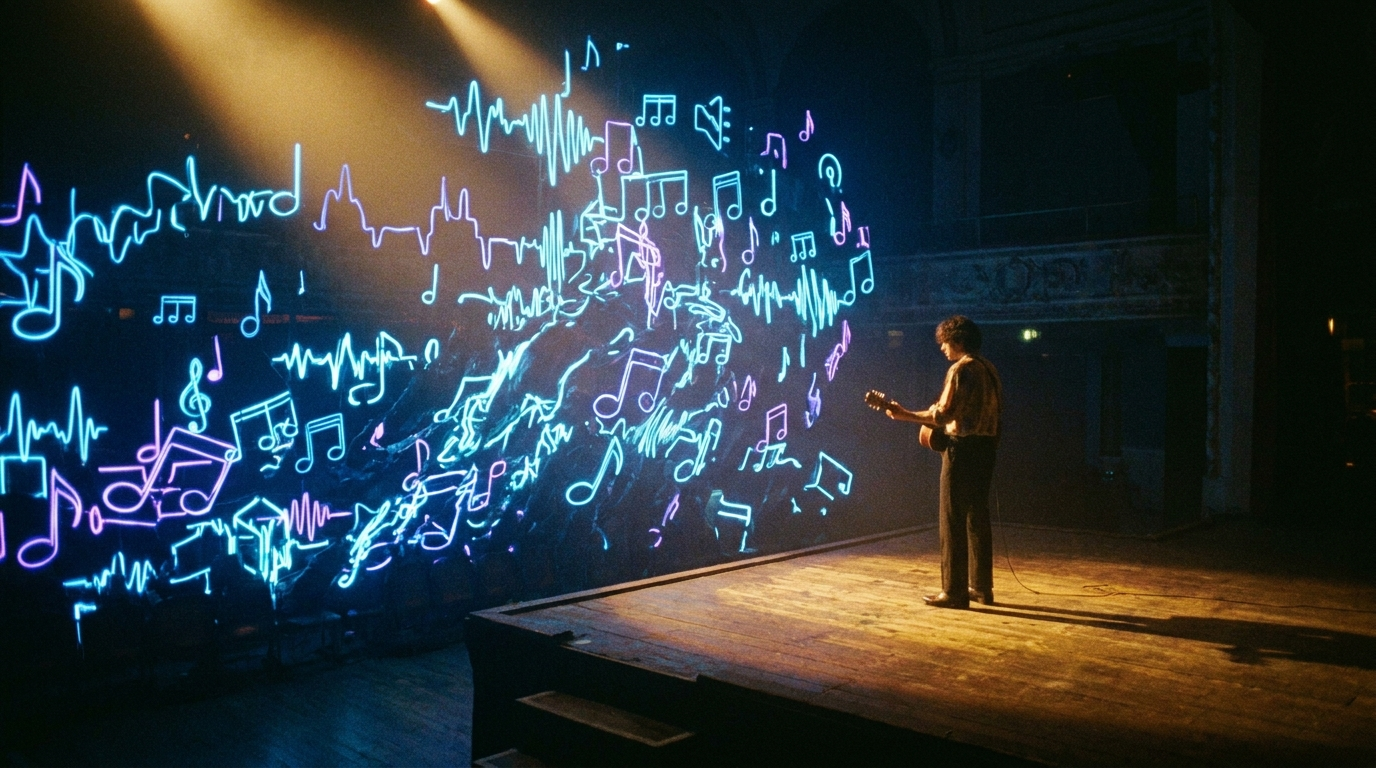
Here’s a number that should make every musician sit up straight: 75,000 fully AI-generated tracks are now uploaded to Deezer every single day. That’s 44% of all new music hitting the platform. Two million synthetic songs a month. And Deezer isn’t even the biggest streaming service — it’s just the only one brave enough to count.
Welcome to the great AI music flood of 2026, where the streaming platforms are finally reckoning with a problem they helped create. The data dropping over the past two weeks paints a picture that’s impossible to ignore — and the implications for real musicians are enormous.
The Numbers Are Staggering
Deezer revealed on April 20 that nearly 75,000 AI-generated tracks are uploaded every day, representing roughly 44% of all daily uploads.
That number has exploded from 10,000 to 75,000 in little over a year.
Then, just days later, Apple Music dropped its own bombshell. VP of Apple Music Oliver Schusser, in an interview with Billboard’s ‘On The Record’ podcast, said: “When you look at our monthly intake, more than a third of what we get today is actually what we would say is music that’s 100% AI.”
Let that sink in. Across two major platforms, somewhere between a third and nearly half of all new music is being created entirely by machines. The generative AI in music market was valued at $642.8 million in 2024 and is projected to reach $3 billion by 2030.
According to the IMS Electronic Music Business Report 2025/26, generative AI and stem separation tools have seen revenue rocket 651% between 2023 and 2025, reaching $333 million with 63 million monthly active users.
The raw volume is mind-bending. But the real story is what’s behind these uploads — and how each platform is choosing to respond.
The Fraud Problem Nobody Wants to Talk About
Here’s the uncomfortable truth: although fully AI-generated music currently accounts for only a small fraction of streams on Deezer — between 1-3% — Deezer has found that up to 85% of the streams generated by fully AI-generated tracks were in fact fraudulent in 2025.
Read that again. Eighty-five percent. Not people discovering new music. Not fans vibing to AI beats. Bots streaming fake songs to steal from the royalty pool that pays real artists.
A 54-year-old North Carolina man pleaded guilty to masterminding a multi-year scheme that sucked away millions in streaming royalties — using AI to create hundreds of thousands of junk songs, then deploying battalions of bots to “listen” to the fake songs automatically.
At peak operation, he was generating revenue from over 660,000 streams a day, roughly $1.2 million a year. And that’s just one guy who got caught.
According to a study conducted by CISAC and PMP Strategy, nearly 25% of creators’ revenues are at risk by 2028, which could amount to as much as €4 billion.
This isn’t an abstract industry debate. If you’re an independent artist relying on streaming income, AI fraud is literally taking money out of your pocket right now.

Three Platforms, Three Very Different Responses
What’s fascinating — and infuriating — is how differently each major platform is handling this crisis. Think of it as a personality test for Big Tech.
Deezer: The Watchdog
Deezer started tagging AI tracks at the platform level in June 2025, becoming the first streaming platform to do so. Their approach is the most aggressive in the industry: songs detected as AI-generated are automatically removed from algorithmic recommendations and are not included in editorial playlists.
Alongside the new data, Deezer announced a fresh operational measure: the platform has now stopped storing hi-res versions of AI-generated tracks, on top of its existing policy of removing such content from recommendations and editorial playlists.
Deezer began commercially licensing its AI detection technology in January this year, with French collecting society Sacem as its first partner, then rolled out the tool to third parties more widely in March.
The company claims it has achieved a false positive rate of less than 0.01%.
A global Deezer-Ipsos survey found that 97% of listeners couldn’t distinguish AI music from human-made tracks, and 80% agreed that fully AI-generated music needs clear labeling. The people have spoken. They can’t tell the difference, and they don’t want to be tricked.
Apple Music: The Honor System
Apple took a very different route. The platform launched Transparency Tags — a system of disclosure labels that record labels and music distributors can begin applying to content delivered to Apple Music immediately, and will be required to use when delivering new content in future.
The framework covers four key creative elements: Artwork, Track, Composition, and Music Video. The Artwork tag flags when AI has been used to generate a material portion of artwork. The Track tag is used when AI generates a material portion of a sound recording.
Sounds good, right? But exactly how that transparency will be enforced remains unclear. Apple’s technical specification describes the tags as “optional” — at least for now — and the system does not appear to include any visible enforcement mechanism or verification process.
Apple’s system is voluntary. Whether labels and distributors will actually use it remains to be seen.
It’s the honor system, basically. Ask the fox to tag itself before entering the henhouse. Bold strategy.
Yet the interesting wrinkle: despite the surge in AI uploads, Schusser asserted that AI music usage on Apple Music remains tiny — “I’m rounding, but it’s below 0.5% of usage.” So the flood exists — but listeners aren’t biting.
Spotify: The Quiet One
And then there’s Spotify, the 800-pound gorilla, which has been… notably cautious. As of April 2026, Spotify launched a beta feature that allows artists to share how they’ve used AI in their music. Where artists have chosen to disclose through their label or distributor, you’ll see credits for specific contributions like vocals, lyrics, or production in Song Credits on mobile.
The key part: artists “choose to disclose.” As Spotify admitted, “because we depend on artist disclosure, the absence of a credit doesn’t mean AI wasn’t used.”
Meanwhile, a Leipzig-based developer named Cedrik Sixtus created a browser tool to identify and block suspected AI artists on Spotify, drawing on community databases and detection software. It filters out a growing list of more than 4,700 suspected AI artists. When your users are building their own enforcement tools, that’s a sign.
Spotify’s official stance: “Our priority is addressing harmful uses [of AI] like spam and impersonation, rather than trying to filter music based on how it was made.”
The EU Enters the Chat
Just when you thought this was purely an industry debate, regulators are stepping in. Starting in August 2026, the EU AI Act’s Article 50 labeling requirement kicks in — and it applies regardless of the platform. Non-compliance may face substantial penalties and sanctions.
The EU’s AI Act introduces clear rules for the public use of artificial intelligence. Under Article 50, anyone publishing AI-generated content must disclose that it wasn’t created by a human — unless the content has been reviewed and approved through a human editorial process.
Failure to comply results in fines of up to 15 million EUR or up to 3% of total global annual turnover, whichever is higher.
This is the hammer that could force platforms to get serious. Spotify’s compliance plan for the EU AI Act remains unclear. The clock is ticking — August 2 is three months away.
What This Means for Musicians Making Music Videos
Here’s where this connects directly to your creative life. The streaming flood isn’t just an audio problem — it’s a visibility problem. When platforms are drowning in millions of synthetic tracks, standing out as a real artist requires more than just great music. You need compelling visual content.
This is exactly why AI music videos have become such a critical tool for legitimate musicians. The irony isn’t lost on us: AI is flooding the streaming platforms with junk music, but AI is also giving real artists the power to create professional-quality visuals that set them apart.
Think about it. By not having an AI tag on your music, you essentially get a “Human-Made” badge of honor. Recent surveys show nearly half of listeners actually want to filter out AI music. On Apple Music, being “AI-free” is becoming a genuine selling point for genres like folk, jazz, and indie rock.
Your music is human. Your story is real. Now you need a video that proves it — fast and affordably. That’s where knowing how to make an AI music video becomes a genuine competitive advantage, not a contradiction.
Whether you’re making hip-hop visuals, EDM content, or indie aesthetics, AI video tools give you the production value that separates “bedroom artist with a Spotify page” from “artist with a visual identity worth following.”

The Survival Playbook for Real Musicians
So how do you thrive in a streaming ecosystem that’s nearly half synthetic? Here’s what the smartest artists are doing:
1. Build a Visual Brand That AI Can’t Replicate
AI can generate a million generic tracks. It cannot generate you. Your face, your performance energy, your aesthetic — these are irreplaceable. Invest in music video content that showcases who you are, not just what you sound like.
2. Tag Your Work Transparently
If you’re using AI as a tool (for mixing, mastering, or visual creation), own it. Using AI for a quick master or to clean up some background hiss usually doesn’t need a “Track” tag. Save the tags for actual generative work so you don’t accidentally tank your algorithmic reach. Transparency builds trust with fans.
3. Leverage the “Human-Made” Advantage
According to the Deezer-Ipsos survey, 52% of respondents said 100% AI-generated songs shouldn’t be included in charts alongside human-made songs, and 80% said AI music should be clearly labeled. Listeners want to support humans. Make it easy for them to find you.
4. Create Video Content for Every Release
In a world where streaming platforms are drowning in audio, video is your lifeline. Music videos for every genre — even lo-fi and jazz — help algorithms and listeners distinguish you from the flood. YouTube is the discovery engine that streaming platforms are not.
5. Diversify Beyond Streaming
Platforms including Bandcamp, Patreon, and Substack have demonstrated that direct-to-fan subscription models can sustain artist careers without major label infrastructure, accelerating the fragmentation of the traditional label-artist relationship. Don’t put all your eggs in the royalty-pool basket.
Where We Go From Here
The AI music flood isn’t slowing down. Naturally, the jump raises multiple questions. One of the biggest: when is this runaway train going to stop?
The honest answer? It probably won’t. What will change is how platforms, regulators, and artists respond. The EU AI Act will force mandatory labeling by August. Deezer’s detection technology will likely spread to other platforms. And artists who build authentic brands with strong visual identities will be the ones who rise above the noise.
AI, for all the challenges it creates, is also giving individual creators tools that were previously available only to well-funded operations. The same technology flooding Spotify with junk is also letting you create a stunning music video in minutes instead of months.
That’s the paradox of 2026: AI is both the flood and the lifeboat. The musicians who understand this will be the ones still standing when the water recedes.
Ready to build visuals that set you apart from the AI flood? OneMoreShot.ai helps real musicians create professional AI music videos in minutes — giving you the visual identity that no content farm can replicate. Because in a world drowning in synthetic music, the best way to prove you’re real is to show it.