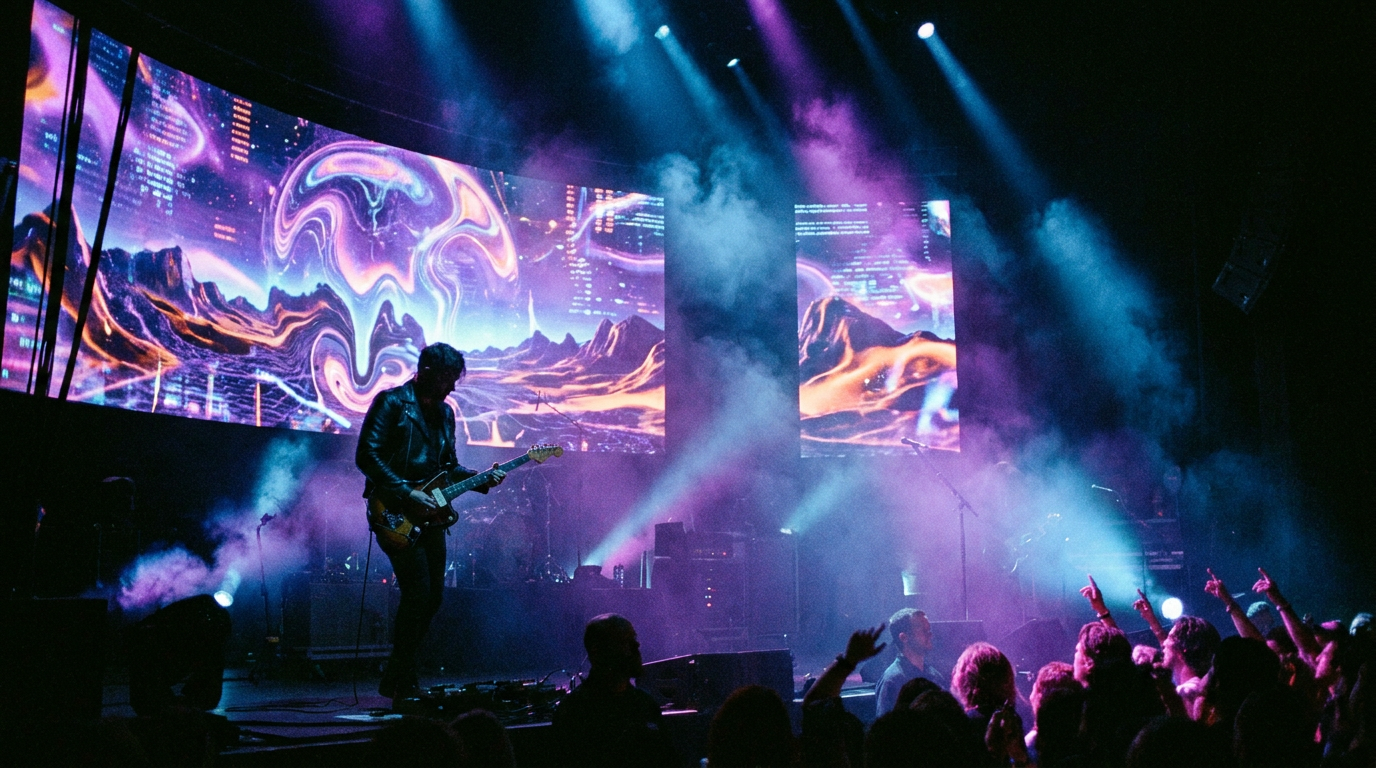
AI Music Videos Just Went Live on Stage
For two years, AI music videos lived on your phone. You’d upload a track, pick a style, wait for the render, and post it to YouTube or TikTok. That workflow changed everything about how independent musicians compete visually — and we’ve covered that story extensively in our complete guide to AI music videos.
But something bigger is happening now. AI-generated visuals are leaving the screen and climbing onto the stage.
Musicians, DJs, and VJs are using real-time AI video generators to power live concert visuals, festival backdrops, and 24/7 streaming channels — and it’s creating an entirely new creative layer that didn’t exist twelve months ago. The tools are ready. The audiences are responding. And the economics are brutal for anyone still hiring traditional VJ crews for five-figure fees.
Here’s what’s happening, why it matters, and how to use it.
From Rendered to Reactive: The Live AI Visual Shift
The AI music video tools you know — the ones we’ve broken down in guides for hip-hop, EDM, pop, and every other genre — work on an asynchronous model. You upload a song. The system processes it. Minutes later, you download a finished video. It’s powerful, but it’s fundamentally a post-production workflow.
Live AI visuals flip that model entirely. Instead of rendering after the fact, these systems generate video in real time as music plays. One platform, freebeat, now lets creators generate concert visuals live as music plays, with its real-time AI engine creating reactive visuals with only 3–5 seconds of latency. That’s not a demo reel stat — as of May 2026, freebeat’s platform has visualized over a billion seconds of music and served over one million creators.
One billion seconds. That’s roughly 31 years of continuous AI-generated concert visuals, produced in under 18 months of the platform’s existence.
And freebeat isn’t alone. Concerts in 2026 now include AI-generated visuals that evolve based on live sound inputs, and the integration of AI in music and stage production has become central to performance design. What was once bleeding-edge is now standard practice at venues ranging from 200-cap clubs to major festival stages.
Why Live AI Visuals Are Exploding Right Now
Three forces converged to make this moment happen.
1. The General-Purpose AI Video Market Collapsed
Remember Sora? OpenAI shut down Sora because it was financially unsustainable — costing roughly $1 million per day to operate but generating only about $2.1 million in total revenue, while a collapsed Disney deal and a focus on profitability ahead of its IPO sealed the decision.
The web and app experiences were discontinued on April 26, 2026, and the Sora API will be discontinued on September 24, 2026.
Sora’s death taught everyone a harsh lesson about platform dependency in AI video. Sora remains both a benchmark and a warning: technical quality alone does not guarantee product durability in AI video. Musicians who built their entire visual workflow around Sora got burned. The smart ones pivoted to music-first tools — platforms that understand song structure, beat mapping, and the specific needs of musicians rather than trying to be everything to everyone.
2. Music-First Tools Got Seriously Good
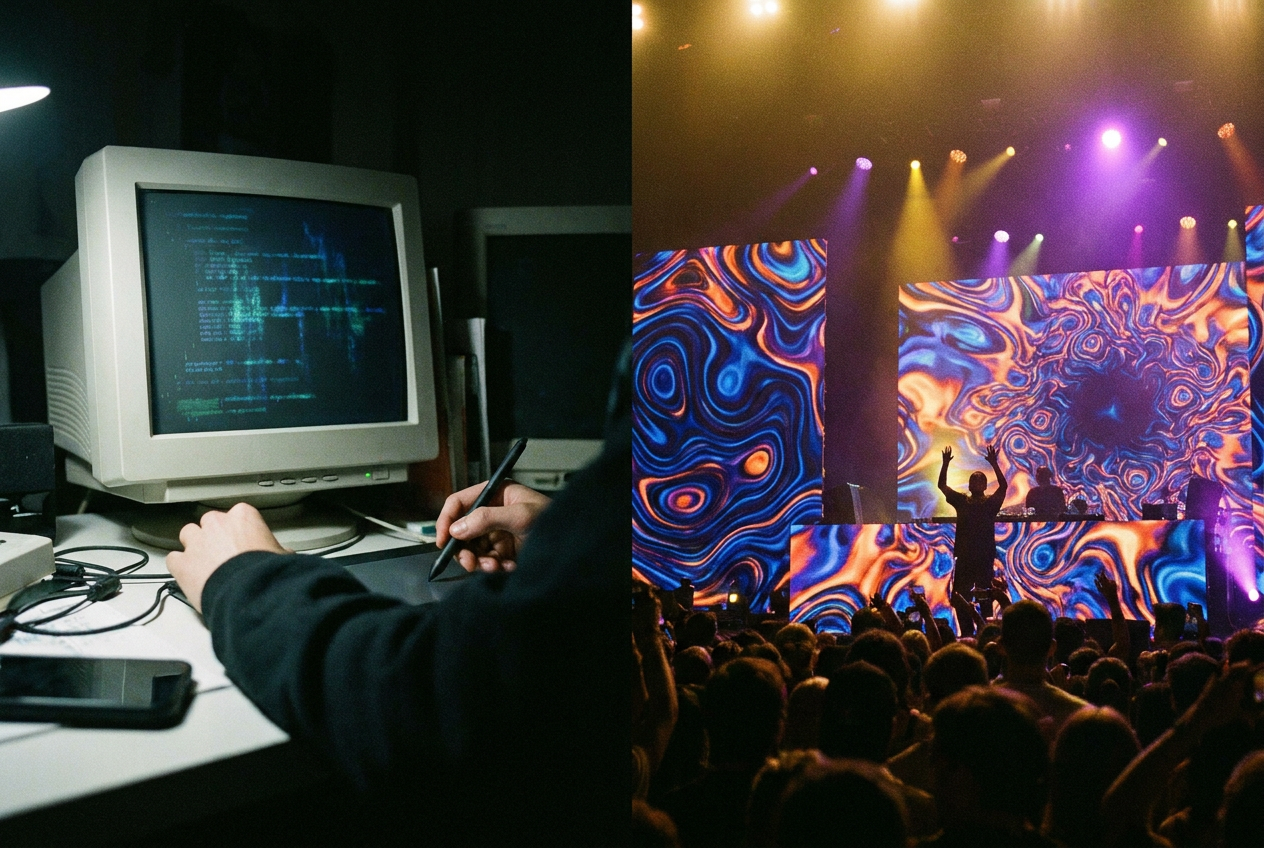
The most significant 2026 trend is the rise of music video generators, with five dedicated platforms entering the market, catering to artists and labels needing rhythm-synced visuals — not just general-purpose video tools bolting on a “music mode,” but full-blown, music-first platforms that understand song structure.
These same platforms are now extending into live territory. The logic is straightforward: if your tool already understands tempo, mood, energy curves, and song sections, generating reactive visuals in real time is a natural next step. AI systems can create a wide range of live performance visuals, from subtle ambient landscapes to complex 3D-rendered storytelling sequences, including reactive stage visuals where concerts include AI visuals that evolve based on live sound inputs.
3. The Content Demand Is Insane
TikTok musicians average 12–15 posts weekly to maintain growth. Instagram requires 4–7 Reels plus Stories. YouTube Shorts favors daily uploads. Creating this volume manually burns out even full-time content creators.
Live AI visuals solve a different version of the same problem. A DJ doing a two-hour set no longer needs to commission custom visuals for every track. An indie band touring with zero production budget can now project AI-generated backdrops that react to their actual performance. And anyone running a 24/7 lo-fi stream can generate an infinite visual loop that never repeats.
What Live AI Visuals Actually Look Like in 2026
Let’s get specific about what’s happening on actual stages.
Reactive Concert Backdrops
Concerts now include visuals that evolve based on live sound inputs — though the AI processing happens asynchronously, cues from prior sets are used to design visuals that feel organically linked to each performance. Artists deploy background LED or digital wall projections generated by AI models that fit the theme, emotion, or tempo of each song.
This is the bread-and-butter use case. Imagine you’re an indie artist playing a 45-minute set at a small venue with an LED wall behind you. Traditionally, you’d either play against a blank wall, loop some stock footage, or spend $2,000–$5,000 on custom visuals. Now you can feed your setlist into an AI visual engine and get a synchronized backdrop for every track.
If you’re doing indie music or rock, this is where the visual templates and aesthetic vocabulary you’ve built for your recorded releases start paying dividends on stage.
DJ and VJ Integration
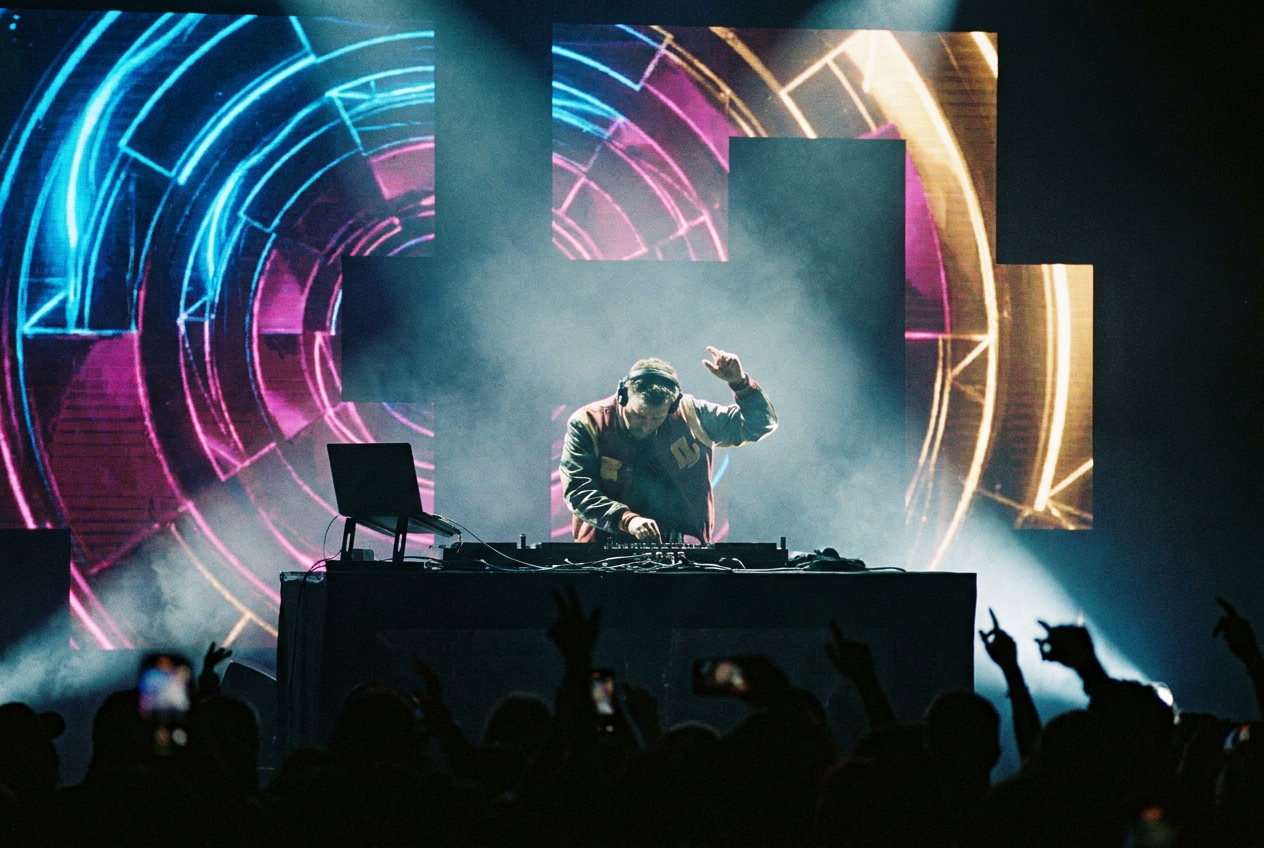
Music stage projections merge 2D and 3D animations driven by AI algorithms, creating unique scenes per track, while hybrid templates for DJs and VJs allow live performers to use pre-made AI visuals that can be layered and remixed in real time.
For EDM artists and DJs, this is arguably the most transformative development. The traditional VJ workflow involved painstaking pre-production: building clip libraries, creating loops, programming triggers, and running complex software during the set. AI collapses that entire chain. Artists, DJs, and VJs from over 150 countries now choose real-time AI engines for their stability, low latency, and the creative freedom to direct a unique visual show for every single performance.
24/7 Streaming Channels
Here’s the use case nobody talks about enough. The wildly successful Lofi Girl channel — 15.6 million subscribers, 2.5 billion total views — understood the visual consistency formula perfectly.
A 24/7 live stream on YouTube can earn 40–60% more revenue per subscriber than regular videos because the monetization window never closes.
AI-generated visuals make 24/7 streams viable for anyone. An AI music video generator solves the visual problem by creating or automating visual layers, keeping your YouTube stream engaging. If you’re building a lo-fi channel or ambient music brand, this might be the single highest-ROI application of AI video in 2026.
Festival-Scale AI Acts
Festivals in 2026 are seeing a surge in AI-generated music where algorithms don’t just mix tracks but dynamically produce stems based on crowd reactions, with AI music competitions now partnering directly with festival brands, allowing winning developer-artist hybrids to secure live bookings.
This is still early, but the direction is unmistakable. Younger audiences, having grown up with virtual influencers and hologram concerts in video games like Fortnite’s virtual shows, are more open to AI-powered performances.
The Economics Make Traditional VJ Work Obsolete
Let’s talk money, because that’s where this gets uncomfortable for a lot of people.
A traditional VJ setup for a touring artist costs $3,000–$10,000 per show when you factor in the VJ’s fee, content licensing, equipment, and travel. A mid-tier festival booking with custom visuals can easily run $15,000–$30,000.
An AI visual subscription? Music-first AI platforms start as low as $19.99/month , and even premium tiers for serious production work cap out at a few hundred dollars. For live reactive visuals specifically, platforms like freebeat offer real-time generation that costs a fraction of hiring a VJ crew.
This doesn’t mean human VJs disappear overnight. The best VJs bring creative direction, taste, and live improvisation that AI can’t replicate yet. But for the 90% of performing musicians who couldn’t afford professional visuals at all? AI just opened a door that was previously bolted shut.
How to Start Using AI Visuals for Live Performance
If you’re a musician who’s already making AI music videos for releases (and if you’re not, start with our guide on how to make an AI music video), extending into live visuals is the natural next step. Here’s the practical playbook.
Step 1: Build Your Visual Identity in Post-Production First
Before you go live, establish a consistent visual language through your recorded music videos. This means developing a coherent aesthetic across your releases — whether that’s the neon-drenched cyberpunk of your K-pop project or the raw, grainy texture of your metal band’s visuals. When you move to live visuals, you’ll want that same identity translating to the stage.
Step 2: Choose a Real-Time Engine
Your options in August 2026 break into two camps:
Music-aware reactive engines that analyze your audio input and generate visuals on the fly. These are the simplest to set up — plug in your audio feed and go.
Pre-rendered AI loops with live triggering where you use an AI video tool to generate a library of clips keyed to specific songs or moods, then trigger them live using traditional VJ software. This gives you more control but requires more prep.
Most performing musicians should start with option two. Generate your visual library using a dedicated AI music video tool, organize clips by song, and trigger them through a basic media server or even a presentation app.
Step 3: Match Your Format to Your Venue
This is where musicians get tripped up. A 16:9 landscape video designed for YouTube won’t work on a vertical LED pillar at a club. Vertical video at 9:16 already accounts for 43.7% of AI video orders, compared to 52.8% for landscape, and that gap is closing — given how platform algorithms increasingly favor native formats, the shift toward vertical-first production is likely to continue.
Think about your venue before you generate. Clubs often have vertical screens. Festivals use ultra-wide aspect ratios. Bars might have multiple small monitors. Generate your AI visuals in the aspect ratio you’ll actually need.
Step 4: Treat Your Live Visuals as Content
Here’s the move most musicians miss: your live AI visuals are content for social media too. Record your set with the visuals visible, clip the best moments, and you’ve got a week’s worth of TikTok and Instagram Reels. AI video systems can batch-produce promotional content from single assets — record one performance or upload one track and generate 20 variations targeted to different platforms.
One show becomes a full content pipeline. Your live AI visuals do double duty as both stage production and social media fuel.
What This Means for the AI Music Video Category
Releasing music in 2026 is no longer just about uploading a track to streaming platforms. Every release now needs a visual life: a YouTube video, short-form clips, social teasers, vertical edits, visual loops, and assets that can travel across TikTok, Instagram Reels, Spotify Canvas, and artist websites.
Live performance is the newest destination on that list. And it’s potentially the most important one, because live shows are the primary revenue driver for independent musicians. If AI visuals can make your $500 bar gig look like a $50,000 festival production, the downstream effects on merch sales, fan engagement, and booking opportunities are enormous.
As one industry observer noted, “AI may end up pushing part of the industry back toward valuing experiences that algorithms simply can’t replicate.” The irony is delicious: AI-generated visuals might be the thing that makes live, in-person music more compelling than ever.
The Bigger Picture
We’re watching AI music videos evolve from a post-production tool into a live creative medium. The same technology that lets you make a music video from your bedroom is now powering stages, streams, and immersive experiences.
The smartest musicians in 2026 aren’t making one music video per song — they’re making five. And music-first platforms make this practical because they understand multi-format output natively.
In 2026, “multi-format” doesn’t just mean YouTube plus TikTok plus Spotify Canvas anymore. It means YouTube plus TikTok plus Spotify Canvas plus your live show plus your 24/7 stream plus your merch-booth screen.
Every surface is a canvas now. The musicians who win will be the ones who fill them all.
Ready to build the visual identity that works across every screen — from your release to your stage? Start creating AI music videos at OneMoreShot.ai and bring your sound to life, everywhere your fans are watching.